



GiroDisc A2-270 Dodge Viper TA Rear Rotors
$1,738.00
GiroDisc A2-270 Dodge Viper TA Iron Rear Rotors
The GiroDisc A2-270 Rear Rotor Kit is a lightweight, performance-engineered brake upgrade for the Dodge Viper TA. Designed to replace the factory rotors directly with no modifications, these 2-piece, fully floating assemblies deliver improved cooling, reduced unsprung weight, and increased responsiveness under hard braking.
Lightweight 2-Piece Construction
Each GiroDisc assembly combines a CNC-machined 6061-T6 aluminum hat with a proprietary high-carbon cast iron rotor ring. The 2-piece floating configuration significantly reduces rotating mass and unsprung weight, resulting in better suspension response, sharper handling, and faster acceleration. These rotors provide superior heat dissipation and a firmer, more consistent brake pedal feel on both street and track.
Race-Proven Floating Mount System
GiroDisc’s advanced floating mount system connects the rotor ring and hat using precision-engineered, cadmium-plated steel drive pins. These pins are secured with grade 12.9 cap screws and hardened washers, allowing the rotors to expand and contract under heat while maintaining axial and radial float. Anti-noise spring washers prevent rattle and ensure quiet operation for street driving.
GiroDisc A2-270 Iron Rear Rotors Fitment Guide
Dodge Viper TA (Time Attack)
Compatible with OEM calipers and pads
Direct bolt-on installation — no modifications required
GiroDisc A2-270 Iron Rear Rotors Specifications
CMS Number: A2-270
Position: Rear
Design: 2-piece floating rotor
Material: Proprietary cast iron rotor with 6061-T6 aluminum hat
Vane Design: Curved internal vanes for enhanced cooling
Hardware: Cadmium-plated drive pins, class 12.9 screws, anti-noise washers
Rebuildable: Yes — replaceable iron rings, reusable aluminum hats
Sold/Price: Per pair
GiroDisc A2-270 Iron Rear Rotors FAQs
Are these rotors a direct replacement for my OEM setup? Yes, the GiroDisc A2-270 rotors are a direct bolt-on replacement for the factory Viper TA rotors and work perfectly with OEM calipers.
What advantages do GiroDisc rotors offer? They provide superior cooling, reduced weight, and improved pedal consistency for both track and street driving.
Can I replace the rings later? Yes, GiroDisc rotors are fully rebuildable—simply replace the iron rotor rings when worn and reuse the aluminum hats.
Do these rotors make noise? No. The anti-noise spring washers eliminate rattling while maintaining the benefits of a fully floating rotor system.
Upgrade your Dodge Viper TA with GiroDisc A2-270 Rear Rotors to experience track-proven braking performance, reduced weight, and long-term serviceability—all proudly engineered and manufactured in the USA.
GiroDisc A1-270 Dodge Viper TA, ACR-X Front Rotors
$1,738.00
GiroDisc A1-270 Dodge Viper TA, ACR-X Front Rotors
The GiroDisc system is a direct replacement for the OE front discs on the Dodge Viper TA and ACR-X. No modifications are necessary—the rotors bolt directly to the car and work seamlessly with factory calipers. By upgrading to these lightweight, high-performance rotors instead of a full big-brake kit, you’ll maintain your OEM brake bias and ABS calibration while dramatically improving braking performance and heat control.
Track-Proven Design, Made in the USA
Each GiroDisc rotor is engineered and machined in the United States using premium materials for maximum reliability under the most demanding conditions. The central hat section is CNC-machined from 6061-T6 aircraft-grade aluminum, while the cast-iron rings are poured from GiroDisc’s proprietary high-carbon alloy for exceptional durability and thermal stability. With a 48-vane directional cooling design, these rotors act as centrifugal pumps, pulling cool air through the disc to reduce fade and extend pad life.
GiroDisc A1-270 Front Rotor Conversion Vehicle Fitment
Dodge Viper TA (Time Attack)
Dodge Viper ACR-X
Dodge Viper SRT (with factory Brembo calipers)
GiroDisc A1-270 Front Rotor Conversion Features
Direct OEM Replacement: Fits factory hubs and calipers—no modifications required.
Lightweight Construction: Significantly reduces unsprung and rotational mass for improved handling and responsiveness.
48 Curved Directional Vanes: Provide superior cooling and consistent performance during repeated hard stops.
Floating Mount System: Uses 8–10 high-strength alloy steel drive pins and anti-noise spring washers for silent, precise operation under thermal expansion.
Made in the USA: Fully machined and assembled at GiroDisc’s facility from domestically sourced materials.
GiroDisc A1-270 Front Rotor Conversion FAQs
Do these rotors fit the OEM calipers? Yes, they’re designed to work perfectly with the stock Brembo calipers on the Viper TA and ACR-X models.
Can these be used for track racing? Absolutely. GiroDisc rotors are built to withstand repeated track abuse while remaining quiet and reliable for street use.
Do they come with hardware? All necessary hardware is included, and installation is a direct bolt-on.
Are they sold individually or in pairs? Each listing is sold and priced per pair.
Upgrade your Dodge Viper’s braking system with GiroDisc lightweight, floating two-piece rotors. Experience reduced fade, quicker cooling, and precise brake modulation for every lap and every stop.

GiroDisc GD355.32.62 355x32mm Replacement Rotor Rings (Wide Annulus)
$1,116.00
GiroDisc GD355.32.62 355x32mm Replacement Rotor Rings (Wide Annulus)
The GiroDisc GD355.32.62 Replacement Rotor Rings (Wide Annulus) are precision-engineered to replace worn iron rings on GiroDisc two-piece brake systems using the D62 hat configuration. These 355x32mm rings are crafted for performance vehicles utilizing Brembo big brake kits that require a wide annulus pad contact area.
Restore Performance with Genuine GiroDisc Components
Manufactured in the USA from GiroDisc’s proprietary cast iron alloy, these rings are engineered for maximum strength, heat resistance, and consistent friction. The wide annulus design provides a larger pad contact area for improved wear balance and braking stability. Each rotor features directional curved vanes that act as a centrifugal pump, pulling cool air through the disc to minimize fade and maintain optimal performance under track conditions.
Features
• Dimensions: 355mm x 32mm (D62 Wide Annulus)• Direct replacement rings for GiroDisc two-piece D62 systems• Designed for use with wide annulus Brembo calipers and pads• Proprietary cast iron alloy poured and machined in the USA• Curved vane internal geometry for maximum cooling• Reuses GiroDisc aluminum hats• Includes new hardware for installation• Sold/priced per pair
Vehicle Fitment
The GiroDisc GD355.32.62 355x32mm Replacement Rotor Rings (Wide Annulus) fit GiroDisc D62-based systems commonly used on:• Brembo 4-piston and 6-piston big brake kits (355mm applications)• Porsche Cayman / Boxster (Brembo GT 355mm systems)• Subaru WRX STI (Brembo GT wide annulus 355mm setup)• Mitsubishi Evo X with Brembo 355mm upgrade• BMW M2 / M3 / M4 with Brembo 355mm GT kitsAlways verify your hat bolt pattern and pad annulus match the D62 configuration before ordering.
GiroDisc GD355.32.62 355x32mm Replacement Rotor Rings (Wide Annulus) FAQs
What does “wide annulus” mean? It refers to the pad contact area width on the rotor. Wide annulus rotors are designed for Brembo GT calipers using pads with a broader friction face.
Can I reuse my aluminum hats? Yes. These replacement rings are designed to bolt directly to GiroDisc aluminum hats using the included hardware.
Do these include hardware? Yes. Each kit includes a complete set of new bolts, washers, and drive pins for proper installation.
Are the rings directional? Yes. Each rotor features left and right curved vane geometry for optimal cooling and airflow direction.
Do they fit OEM or other aftermarket hats? No. GiroDisc replacement rings are specifically machined for GiroDisc D62 aluminum hats and are not compatible with other brands.
Are they sold as a pair? Yes. The GiroDisc GD355.32.62 355x32mm Replacement Rotor Rings (Wide Annulus) are sold and priced per pair and include a complete hardware kit.
Keep your braking system at peak performance with GiroDisc GD355.32.62 355x32mm Replacement Rotor Rings (Wide Annulus)—the perfect OEM-quality solution for maintaining the precision, cooling, and durability your GiroDisc system was designed for.

Ferodo FCP1334 Rear Brake Pads
from $725.00
Ferodo FCP1334 Rear Brake Pads
Ferodo FCP1334 Brake Pad Fitment Guide
Make
Model
Build (Year)
Front
Rear
Aston Martin
DB9
04 - 16
X
Aston Martin
DB11 [cast iron brakes]
16 - 23
X
Aston Martin
Vantage [cast iron brakes] street car
18 -
X
Aston Martin
Vantage V8 GT4 ProDrive [race car] stock OE caliper
12 -
X
Audi
RS3 Sportback [8PA]
11 - 12
X
Audi
TT RS 2.5 Quattro
09 - 14
X
Cadillac
CTS-V (4 piston front caliper)
03 - 09
X
Chevrolet
Camaro SS [Gen 5]
09 - 15
X
Chevrolet
Camaro SS [Gen 6] 4 Piston Brembo caliper
16 -
X
Chevrolet
Corvette C6 Brembo 6 piston non ceramic
09 - 13
X
Chevrolet
Corvette C7 base
13 - 20
X
Chevrolet
Corvette C7 Z51
14 -
X
Dodge
Viper SRT TA (time attack)
14 - 17
X
X
Ford
GT
04 - 06
X
X
Ford
Ford GT (second generation) ceramic brakes
17 -
X
Ford
Mustang Boss 302
12 - 13
X
Ford
Mustang GT [4 piston Brembo]
11 - 14
X
Ford
Mustang Shelby GT500 [4 piston Brembo caliper / 15 disc]
07 - 14
X
Honda (Acura)
Civic Type R [Brembo brakes] IX and X generation
15 -
X
Hyundai
Genesis Coupe 3.8 track
10 - 16
X
KIA
Stinger 3.3 T-GDI V6 [4 piston Brembo]
18-
X
Maserati
Ghibli (M157) [4 piston Brembo caliper / disc ø 345mm]
13 -
X
Mitsubishi
Lancer Evo V - Evo IX
98 - 06
X
Mitsubishi
Lancer Evo X
07 - 16
X
Renault
Mégane III 2.0 RS [Brembo brakes] without electronic hand brake
08 - 16
X
Subaru
STI 3rd & 4th generation
03 - 16
X
Volvo
S60 Turbo R Brembo brakes
03 - 07
X
Volvo
V70 R 2.5T Brembo brakes
03 - 07
X
Make
Model
Engine / Variant
Years
Front Pad Shape
Rear Pad Shape
Ferrari
488 Challenge
3.9L
2016+
FRP3106
FCP1334
Ferrari
488 GTB
4.0L
2015–2020
FRP3106
FCP1334
Ferrari
458 Spider
4.5L
2009–2015
FRP3106
FCP1334
Ferrari
458 Challenge
4.5L
2010+
FRP3106
FCP1334
Ferodo DS3.12 Brake Compound Details
The DS3.12 is the latest evolution in Ferodo's incredible DS line. Sports cars today have more of everything: more horsepower, more sophisticated aero, higher curb weights, and stickier tires. These attributes place serious demands on a vehicle's brake system. The Ferodo DS3.12 is the modern pad compound designed from the start to explicitly handle those demands.
The Ferodo DS3.12 is a top-tier endurance racing brake pad compound built for maximum fade resistance, high friction, and extremely consistent performance at elevated temperatures. If you need a Ferodo track brake pad for aggressive braking, long sessions, and serious motorsport use, DS3.12 is one of the strongest options in the lineup.
The DS3.12 compound provides strong initial bite, a highly stable torque curve, and dependable braking performance in demanding track conditions. It is ideal for experienced drivers, endurance racing, and high-grip applications where repeatable stopping power matters most.
Maximum fade resistance in the Ferodo range
High friction and strong initial bite
Very consistent braking response at track temperatures
Excellent durability in endurance racing use
Best for: advanced track-day drivers and racers who want a high-performance race brake pad with elite heat capacity and confidence-inspiring consistency.
Note: DS3.12 is a full race compound and may produce increased dust, disc wear, and reduced cold performance compared with street-oriented pads.
Ferodo DS1.11 Brake Compound Details
The DS1.11 has a lower mu than the DS3.12 at all temperatures and can be characterized as a moderate mu pad vs. other endurance racing compounds. They require more pedal force than the DS3.12, and they have a slightly declining torque curve as temperatures rise. As they get hotter and you dive deeper into a turn, you may feel like you need to push a little harder on the brake pedal to elicit the same response (which is a feel many drivers actually prefer). Some drivers feel that the DS1.11 is more controllable on street tires than DS3.12 since ABS cannot be activated as easily. It will last a fairly long time vs. many other pad compounds on the market but does not last quite as long as the DS3.12. They are very gentle on discs at track temperatures when a proper pad transfer layer is maintained. The DS1.11 also has an outstanding max temp and fade resistance, just not quite as high as 3.12. We're not aware of anyone who has faded them, and most people differentiate between the DS1.11 and DS3.12 based on feel.
The Ferodo DS1.11 is a proven endurance racing brake pad compound designed for drivers who need outstanding fade resistance, long pad life, and precise control under repeated high-temperature braking. For track cars and serious HPDE builds, DS1.11 is a trusted Ferodo race brake pad with a strong reputation for consistency.
This DS1.11 features stable braking performance, excellent modulation, and durability in demanding track conditions. Compared with more street-focused compounds, DS1.11 is better suited to aggressive lapping, endurance sessions, and drivers who value a progressive pedal feel.
Exceptional fade resistance for track use
Long wear characteristics in endurance-style driving
Progressive, controllable pedal feel
Excellent choice for HPDE and racing applications
Best for: drivers looking for a track brake pad with durability, modulation, and high-temperature stability for repeated hard use.
Note: DS1.11 is a race compound and is not ideal for customers seeking low noise, low dust, or refined street manners.
Ferodo DSUNO Brake Compound Details
For our customers who enjoy the performance of the DS1.11, but just want a little more bite, we recommend the DSUNO. It doesn't wear quite as long as the DS1.11, but it does offer a higher overall mu once it reaches track temperatures.
Ferodo DS2500 Compound Details
Although we always recommend using a dedicated race pad for the track, the DS2500 is one of the best hybrid street/track pads on the market. It features the moderately high bite and solid fade resistance of a track pad, with the relatively low dust and noise levels of a street pad. When used as a street pad, it can produce some squeal on certain vehicle platforms. If you drive aggressively on the street, do some canyon runs, autocross, and maybe some light track duty on street tires, the DS2500 is tough to beat.
The Ferodo DS2500 is one of the most popular performance brake pad compounds for drivers who want strong braking on the street and dependable performance at the track. If you are looking for a street and track brake pad with excellent cold bite, low noise, and impressive fade resistance, the DS2500 is a proven choice.
The DS2500 delivers confident pedal feel, consistent stopping power, and better high-temperature performance than typical street pads. It is an excellent option for spirited driving, autocross, HPDE, and dual-purpose performance cars.
Strong cold bite for street use
Low noise when properly bedded
Excellent fade resistance for a dual-purpose pad
Great match for performance street tires
Best for: drivers who want a versatile Ferodo brake pad for daily driving, canyon runs, and light to moderate track use without giving up refinement.
Note: DS2500 is a race-derived compound and may produce more dust than an ordinary OEM street pad.
Ferodo DS3000 Brake Compound Details
The predecessor to DS1.11, DS3000 offers high initial bite with excellent feel and release. Popular among rally teams, DS3000 has a relatively low cold temperature threshold while still offering high temp stability for tarmac. DS3000 is very easy on discs at the expense of pad wear.
Ferodo FCP1334 Comparison Chart
Out of all the pad compounds we've ever tested, from all manufacturers, the Ferodo DS3.12 shows the flattest torque curve across the broadest temperature range. That means on every turn, on every track you drive, on every lap, your brake pedal is going to feel almost exactly the same, providing tremendous consistency and repeatability. The DS3.12 has a higher mu (µ) than Ferodo's other compounds, so not as much pedal pressure is required to initiate the desired response. It is also un-fadable, showing no drop in performance at any temperature your brakes will ever see.
Ferodo FCP1334 Coefficient of Friction (Mu) Comparison Chart
In dyno testing, the Ferodo DS3.12 has shown superior wear rates to the other Ferodo compounds, while remaining kind to brake rotors. We believe the Ferodo DS3.12 will become the gold standard by which other race compounds will be judged.
Ferodo FCP1334 Operating Temperature Comparison Chart
**Designed for use with iron brake rotors only. Not for use with carbon-ceramic rotors.**
Ferodo FCP1334 Brake Pads (Front)
from $725.00
Ferodo FCP1334 Front Brake Pads
Ferodo FCP1334 Brake Pad Fitment Guide
Make
Model
Build (Year)
Front
Rear
Aston Martin
DB9
04 - 16
X
Aston Martin
DB11 [cast iron brakes]
16 - 23
X
Aston Martin
Vantage [cast iron brakes] street car
18 -
X
Aston Martin
Vantage V8 GT4 ProDrive [race car] stock OE caliper
12 -
X
Audi
RS3 Sportback [8PA]
11 - 12
X
Audi
TT RS 2.5 Quattro
09 - 14
X
Cadillac
CTS-V (4 piston front caliper)
03 - 09
X
Chevrolet
Camaro SS [Gen 5]
09 - 15
X
Chevrolet
Camaro SS [Gen 6] 4 Piston Brembo caliper
16 -
X
Chevrolet
Corvette C6 Brembo 6 piston non ceramic
09 - 13
X
Chevrolet
Corvette C7 base
13 - 20
X
Chevrolet
Corvette C7 Z51
14 -
X
Dodge
Viper SRT TA (time attack)
14 - 17
X
X
Ford
GT
04 - 06
X
X
Ford
Ford GT (second generation) ceramic brakes
17 -
X
Ford
Mustang Boss 302
12 - 13
X
Ford
Mustang GT [4 piston Brembo]
11 - 14
X
Ford
Mustang Shelby GT500 [4 piston Brembo caliper / 15 disc]
07 - 14
X
Honda (Acura)
Civic Type R [Brembo brakes] IX and X generation
15 -
X
Hyundai
Genesis Coupe 3.8 track
10 - 16
X
KIA
Stinger 3.3 T-GDI V6 [4 piston Brembo]
18-
X
Maserati
Ghibli (M157) [4 piston Brembo caliper / disc ø 345mm]
13 -
X
Mitsubishi
Lancer Evo V - Evo IX
98 - 06
X
Mitsubishi
Lancer Evo X
07 - 16
X
Renault
Mégane III 2.0 RS [Brembo brakes] without electronic hand brake
08 - 16
X
Subaru
STI 3rd & 4th generation
03 - 16
X
Volvo
S60 Turbo R Brembo brakes
03 - 07
X
Volvo
V70 R 2.5T Brembo brakes
03 - 07
X
Make
Model
Engine / Variant
Years
Front Pad Shape
Rear Pad Shape
Ferrari
488 Challenge
3.9L
2016+
FRP3106
FCP1334
Ferrari
488 GTB
4.0L
2015–2020
FRP3106
FCP1334
Ferrari
458 Spider
4.5L
2009–2015
FRP3106
FCP1334
Ferrari
458 Challenge
4.5L
2010+
FRP3106
FCP1334
Ferodo DS3.12 Brake Compound Details
The DS3.12 is the latest evolution in Ferodo's incredible DS line. Sports cars today have more of everything: more horsepower, more sophisticated aero, higher curb weights, and stickier tires. These attributes place serious demands on a vehicle's brake system. The Ferodo DS3.12 is the modern pad compound designed from the start to explicitly handle those demands.
The Ferodo DS3.12 is a top-tier endurance racing brake pad compound built for maximum fade resistance, high friction, and extremely consistent performance at elevated temperatures. If you need a Ferodo track brake pad for aggressive braking, long sessions, and serious motorsport use, DS3.12 is one of the strongest options in the lineup.
The DS3.12 compound provides strong initial bite, a highly stable torque curve, and dependable braking performance in demanding track conditions. It is ideal for experienced drivers, endurance racing, and high-grip applications where repeatable stopping power matters most.
Maximum fade resistance in the Ferodo range
High friction and strong initial bite
Very consistent braking response at track temperatures
Excellent durability in endurance racing use
Best for: advanced track-day drivers and racers who want a high-performance race brake pad with elite heat capacity and confidence-inspiring consistency.
Note: DS3.12 is a full race compound and may produce increased dust, disc wear, and reduced cold performance compared with street-oriented pads.
Ferodo DS1.11 Brake Compound Details
The DS1.11 has a lower mu than the DS3.12 at all temperatures and can be characterized as a moderate mu pad vs. other endurance racing compounds. They require more pedal force than the DS3.12, and they have a slightly declining torque curve as temperatures rise. As they get hotter and you dive deeper into a turn, you may feel like you need to push a little harder on the brake pedal to elicit the same response (which is a feel many drivers actually prefer). Some drivers feel that the DS1.11 is more controllable on street tires than DS3.12 since ABS cannot be activated as easily. It will last a fairly long time vs. many other pad compounds on the market but does not last quite as long as the DS3.12. They are very gentle on discs at track temperatures when a proper pad transfer layer is maintained. The DS1.11 also has an outstanding max temp and fade resistance, just not quite as high as 3.12. We're not aware of anyone who has faded them, and most people differentiate between the DS1.11 and DS3.12 based on feel.
The Ferodo DS1.11 is a proven endurance racing brake pad compound designed for drivers who need outstanding fade resistance, long pad life, and precise control under repeated high-temperature braking. For track cars and serious HPDE builds, DS1.11 is a trusted Ferodo race brake pad with a strong reputation for consistency.
This DS1.11 features stable braking performance, excellent modulation, and durability in demanding track conditions. Compared with more street-focused compounds, DS1.11 is better suited to aggressive lapping, endurance sessions, and drivers who value a progressive pedal feel.
Exceptional fade resistance for track use
Long wear characteristics in endurance-style driving
Progressive, controllable pedal feel
Excellent choice for HPDE and racing applications
Best for: drivers looking for a track brake pad with durability, modulation, and high-temperature stability for repeated hard use.
Note: DS1.11 is a race compound and is not ideal for customers seeking low noise, low dust, or refined street manners.
Ferodo DSUNO Brake Compound Details
For our customers who enjoy the performance of the DS1.11, but just want a little more bite, we recommend the DSUNO. It doesn't wear quite as long as the DS1.11, but it does offer a higher overall mu once it reaches track temperatures.
Ferodo DS2500 Compound Details
Although we always recommend using a dedicated race pad for the track, the DS2500 is one of the best hybrid street/track pads on the market. It features the moderately high bite and solid fade resistance of a track pad, with the relatively low dust and noise levels of a street pad. When used as a street pad, it can produce some squeal on certain vehicle platforms. If you drive aggressively on the street, do some canyon runs, autocross, and maybe some light track duty on street tires, the DS2500 is tough to beat.
The Ferodo DS2500 is one of the most popular performance brake pad compounds for drivers who want strong braking on the street and dependable performance at the track. If you are looking for a street and track brake pad with excellent cold bite, low noise, and impressive fade resistance, the DS2500 is a proven choice.
The DS2500 delivers confident pedal feel, consistent stopping power, and better high-temperature performance than typical street pads. It is an excellent option for spirited driving, autocross, HPDE, and dual-purpose performance cars.
Strong cold bite for street use
Low noise when properly bedded
Excellent fade resistance for a dual-purpose pad
Great match for performance street tires
Best for: drivers who want a versatile Ferodo brake pad for daily driving, canyon runs, and light to moderate track use without giving up refinement.
Note: DS2500 is a race-derived compound and may produce more dust than an ordinary OEM street pad.
Ferodo DS3000 Brake Compound Details
The predecessor to DS1.11, DS3000 offers high initial bite with excellent feel and release. Popular among rally teams, DS3000 has a relatively low cold temperature threshold while still offering high temp stability for tarmac. DS3000 is very easy on discs at the expense of pad wear.
Ferodo FCP1334 Comparison Chart
Out of all the pad compounds we've ever tested, from all manufacturers, the Ferodo DS3.12 shows the flattest torque curve across the broadest temperature range. That means on every turn, on every track you drive, on every lap, your brake pedal is going to feel almost exactly the same, providing tremendous consistency and repeatability. The DS3.12 has a higher mu (µ) than Ferodo's other compounds, so not as much pedal pressure is required to initiate the desired response. It is also un-fadable, showing no drop in performance at any temperature your brakes will ever see.
Ferodo FCP1334 Coefficient of Friction (Mu) Comparison Chart
In dyno testing, the Ferodo DS3.12 has shown superior wear rates to the other Ferodo compounds, while remaining kind to brake rotors. We believe the Ferodo DS3.12 will become the gold standard by which other race compounds will be judged.
Ferodo FCP1334 Operating Temperature Comparison Chart
**Designed for use with iron brake rotors only. Not for use with carbon-ceramic rotors.**
Pagid Racing 2487 Brake Pads (Front)
from $628.00
Pagid Racing Brake Pad Shape 2487
Fitment Guide Pagid 2487 Brake Pad (FMSI 2487)
Make
Model
Build (Year)
Front
Rear
Aston Martin
DB9
04 - 16
X
Aston Martin
Vantage V8 GT4 ProDrive [race car] stock OE caliper
12 -
X
Audi
RS3 Sportback [8PA]
11 - 12
X
Audi
TT RS 2.5 Quattro
09 - 14
X
Cadillac
CTS-V (4 piston front caliper)
03 - 09
X
Chevrolet
Camaro SS [Gen 5]
09 - 15
X
Chevrolet
Camaro SS [Gen 6] 4 Piston Brembo caliper
16 -
X
Chevrolet
Corvette C7 base
13 - 20
X
Chevrolet
Corvette C7 Z51
14 -
X
Dodge
Viper SRT TA (time attack)
14 - 17
X
Ford
GT
04 - 06
X
Ford
Mustang Boss 302
12 - 13
X
Ford
Mustang GT [4 piston Brembo]
11 - 14
X
Ford
Mustang Shelby GT500 [4 piston Brembo caliper / 15" disc]
07 - 14
X
Honda
Civic Type R [Brembo brakes] FK2, FK8
15 -
X
Hyundai
Genesis Coupe 3.8 track
10 - 16
X
KIA
Stinger 3.3 T-GDI V6 [4 piston Brembo]
18-
X
Maserati
Ghibli (M157) [4-piston Brembo caliper / disc ø 345mm]
13 -
X
Mitsubishi
Lancer Evo V - Evo IX
98 - 06
X
Mitsubishi
Lancer Evo X
07 - 16
X
Subaru
STI 3rd & 4th generation
03 - 16
X
Volvo
S60 Turbo R Brembo brakes
03 - 07
X
Volvo
V70 R 2.5T Brembo brakes
03 - 07
X
Fits the Following Calipers:
Make
Type
Remarks
Shape No.
Brembo
M4 in combination w/ 62mm radial disc swept depth
16mm
2487
Pagid Racing Brake Pads are engineered for high-performance driving, delivering exceptional stopping power, durability, and control under the most demanding conditions. Trusted by professional racers and performance enthusiasts worldwide, these pads are crafted using advanced friction materials and cutting-edge technology to ensure consistent performance, low fade, and excellent modulation. Whether you're on the track or tackling aggressive street driving, Pagid Racing Brake Pads provide the reliability and confidence you need to push your vehicle to its limits.
Pagid Racing Brake compounds are for steel (cast iron) rotors only unless otherwise noted.
Pagid Racing 2487 Brake Pad RSL 29 Compound
The Pagid RSL 29 (Yellow) is the world-leading endurance brake pad used by most of the winning teams in motorsport. Although designed primarily for endurance racing, many competitors use this material successfully for sprint and short distance races also. RS29 has also found favor in the growing track day market due to the level of control, good cold performance, long life and low disc wear.
Pagid Racing 2487 Brake Pad RSL 1 Compound
Used in GT cars, touring cars and prototype endurance racing. Due to the high friction and good modulation, often used in sprint races as well. RSL 1 is a low metallic resin bonded material containing steel and aramid fibers with very high heat resistance. It maintains a constant friction level over a wide range of temperatures. Its reduced wear rate and disc friendliness make this material appropriate for endurance races.
Pagid Racing 2487 Brake Pad RST 1 Compound
Used in Rally tarmac, GT cars and touring cars circuit racing (sprint), high down-force formula cars, NASCAR. Suitable for applications in heavy cars and where high torque is necessary against small diameter rotors. RST 1 has a very high friction level and high temperature resistance. It is a semi-metallic resin bonded material containing steel fibers. Cold friction and initial bite makes this material most appropriate for Rally and NASCAR applications.
Pagid Racing 2487 Brake Pad RST 3 Compound
RST 3 is a medium-high friction metal-ceramic compound containing steel fibers and is therefore the perfect complement of the RST product family. It captivates by its low heat conductivity. Rally tarmac and gravel, GT cars, touring cars and prototype circuit racing, formula cars and club racing. Wide range of applications due to it‘s combination of bite, friction and controllability.
Pagid Racing 2487 Brake Pad RST 4 Compound
RST 4 is a semi-metallic resin bonded material containing steel fibers. This material has a medium friction level and high temperature resistance. Typically use is in formula cars and open wheel racing. It is also very popular as a rear-axle material for rally racing (tarmac and gravel) and for front engine cars. Also used in NASCAR on long ovals.
Pagid Racing 2487 Brake Pads (Rear)
from $628.00
Pagid Racing Brake Pad Shape 2487
Fitment Guide Pagid 2487 Brake Pad (FMSI D1001)
Make
Model
Build (Year)
Front
Rear
Aston Martin
DB9
2004 - 16
X
Aston Martin
DB11 [cast iron brakes]
2016 - 23
X
Aston Martin
Vantage [cast iron brakes] street car
2018+
X
Aston Martin
Vantage V8 GT4 ProDrive [race car] stock OE caliper
2012+
X
Audi
RS3 Sportback [8PA]
2011 - 12
X
Audi
TT RS 2.5 Quattro
2009 - 14
X
Cadillac
CTS-V (4 piston front caliper)
2003 - 09
X
Chevrolet
Camaro SS [Gen 5]
2009 - 15
X
Chevrolet
Camaro SS [Gen 6] 4 Piston Brembo caliper
2016+
X
Chevrolet
Corvette C6 Brembo 6 piston non ceramic
2009 - 13
X
Chevrolet
Corvette C7 base
2013 - 20
X
Chevrolet
Corvette C7 Z51
2014+
X
Dodge
Viper SRT TA (time attack)
2014 - 17
X
X
Ford
GT
2004 - 06
X
X
Ford
Ford GT (Gen 2) w/ ceramic brakes
2017 - 20
X
Pagid Racing Brake Pads are engineered for high-performance driving, delivering exceptional stopping power, durability, and control under the most demanding conditions. Trusted by professional racers and performance enthusiasts worldwide, these pads are crafted using advanced friction materials and cutting-edge technology to ensure consistent performance, low fade, and excellent modulation. Whether you're on the track or tackling aggressive street driving, Pagid Racing Brake Pads provide the reliability and confidence you need to push your vehicle to its limits.
Pagid Racing Brake compounds are for steel (cast iron) rotors only unless otherwise noted.
Pagid Racing 2487 Brake Pad RSL 29 Compound
The Pagid RSL 29 (Yellow) is the world-leading endurance brake pad used by most of the winning teams in motorsport. Although designed primarily for endurance racing, many competitors use this material successfully for sprint and short distance races also. RS29 has also found favor in the growing track day market due to the level of control, good cold performance, long life and low disc wear.
Pagid Racing 2487 Brake Pad Pagid RSL 1 Compound
Used in GT cars, touring cars and prototype endurance racing. Due to the high friction and good modulation, often used in sprint races as well. RSL 1 is a low metallic resin bonded material containing steel and aramid fibers with very high heat resistance. It maintains a constant friction level over a wide range of temperatures. Its reduced wear rate and disc friendliness make this material appropriate for endurance races.
Pagid Racing 2487 Brake Pad Pagid RST 1 Compound
Used in Rally tarmac, GT cars and touring cars circuit racing (sprint), high down-force formula cars, NASCAR. Suitable for applications in heavy cars and where high torque is necessary against small diameter rotors. RST 1 has a very high friction level and high temperature resistance. It is a semi-metallic resin bonded material containing steel fibers. Cold friction and initial bite makes this material most appropriate for Rally and NASCAR applications.
Pagid Racing 2487 Brake Pad Pagid RST 3 Compound
RST 3 is a medium-high friction metal-ceramic compound containing steel fibers and is therefore the perfect complement of the RST product family. It captivates by its low heat conductivity. Rally tarmac and gravel, GT cars, touring cars and prototype circuit racing, formula cars and club racing. Wide range of applications due to it‘s combination of bite, friction and controllability.
Pagid Racing 2487 Brake Pad Pagid RST 4 Compound
RST 4 is a semi-metallic resin bonded material containing steel fibers. This material has a medium friction level and high temperature resistance. Typically use is in formula cars and open wheel racing. It is also very popular as a rear-axle material for rally racing (tarmac and gravel) and for front engine cars. Also used in NASCAR on long ovals.
Performance Friction PFC 7781 Brake Pads (Front)
$601.00
Performance Friction PFC Racing Brake Pad Shape 7781
Fitment Guide PFC 7781 Brake Pad (FMSI 2487)
Make
Model
Build (Year)
Front
Rear
Aston Martin
DB9
04 - 16
X
Aston Martin
Vantage V8 GT4 ProDrive [race car] stock OE caliper
12 -
X
Audi
RS3 Sportback [8PA]
11 - 12
X
Audi
TT RS 2.5 Quattro
09 - 14
X
Cadillac
CTS-V (4 piston front caliper)
03 - 09
X
Chevrolet
Camaro SS [Gen 5]
09 - 15
X
Chevrolet
Camaro SS [Gen 6] 4 Piston Brembo caliper
16 -
X
Chevrolet
Corvette C7 base
13 - 20
X
Chevrolet
Corvette C7 Z51
14 -
X
Dodge
Viper SRT TA (time attack)
14 - 17
X
Ford
GT
04 - 06
X
Ford
Mustang Boss 302
12 - 13
X
Ford
Mustang GT [4 piston Brembo]
11 - 14
X
Ford
Mustang Shelby GT500 [4 piston Brembo caliper / 15" disc]
07 - 14
X
Honda
Civic Type R [Brembo brakes] Gen IX and X
15 -
X
Hyundai
Genesis Coupe 3.8 track
10 - 16
X
KIA
Stinger 3.3 T-GDI V6 [4 piston Brembo]
18-
X
Maserati
Ghibli (M157) [4-piston Brembo caliper / disc ø 345mm]
13 -
X
Mitsubishi
Lancer Evo V - Evo IX
98 - 06
X
Mitsubishi
Lancer Evo X
07 - 16
X
Subaru
STI 3rd & 4th generation
03 - 16
X
Volvo
S60 Turbo R Brembo brakes
03 - 07
X
Volvo
V70 R 2.5T Brembo brakes
03 - 07
X
Fits the Following Calipers:
Make
Type
Remarks
Shape No.
Brembo
M4 in combination w/ 62mm radial disc swept depth
16mm
2487
Performance Friction Compound Performance Graph
Performance Friction Brake Compounds
The Performance Friction PFC 7781 racing brake pad features a specialized backing plate and friction surface designed for compatible high-performance brake calipers. With a 132 mm overall width, 77 mm overall height, 62 mm friction material depth, and 15 mm friction material thickness, the PFC 7781 provides a precisely defined pad shape for demanding motorsport braking applications.
Available through Competition Motorsport, the PFC 7781 is designed for drivers and racing teams seeking Performance Friction braking technology for HPDE, track days, club racing, and competitive motorsport. Selecting the correct pad shape and friction compound is essential for achieving predictable braking response, proper caliper fitment, and consistent performance.
PFC 7781 Brake Pad Specifications
Manufacturer: Performance Friction (PFC)
Pad Shape: 7781
Overall Width: 132 mm
Overall Height: 77 mm
Friction Material Depth: 62 mm
Friction Material Thickness: 15 mm (excluding backing plate)
Friction Surface: Curved profile with two angled grooves
Application: Compatible performance and motorsport brake calipers
Precision PFC 7781 Brake Pad Geometry
The PFC 7781 features two upper mounting holes, a distinctive backing plate profile, and a curved friction surface with two angled grooves. Its shallow concave lower edge and specialized mounting geometry distinguish it from other racing brake pad shapes.
These details are important when identifying replacement brake pads, particularly for vehicles equipped with aftermarket racing calipers or optional high-performance brake systems.
Performance Friction Racing Brake Technology
Performance Friction develops advanced racing brake pads and braking systems for demanding motorsport applications. Its competition-focused friction materials are engineered to deliver braking characteristics suited to different vehicles, operating temperatures, and racing requirements.
Depending on the selected compound, PFC racing brake pads can offer different combinations of initial bite, brake torque, modulation, temperature stability, and wear characteristics.
Why Choose PFC 7781 Racing Brake Pads?
Precision backing plate geometry for compatible racing calipers
132 mm overall width and 77 mm overall height
62 mm friction material depth
15 mm friction material thickness
Distinctive dual-groove friction surface
Performance Friction motorsport braking technology
PFC 7781 Brake Pad Fitment and Compatibility
Correct brake pad fitment requires matching the backing plate outline, mounting-hole locations, friction surface geometry, and pad thickness to the vehicle's brake caliper.
Before ordering, compare your existing pads with the PFC 7781 technical drawing. Confirm the 132 mm overall width, 77 mm overall height, 62 mm friction depth, and 15 mm friction material thickness.
The 15 mm thickness measurement excludes the steel backing plate. It should not be confused with the complete assembled brake pad thickness.
Vehicle make and model alone may not establish compatibility, particularly when aftermarket racing calipers or optional performance brake packages are installed.
Frequently Asked Questions About PFC 7781 Brake Pads
What are the dimensions of the PFC 7781 brake pad?
The PFC 7781 measures 132 mm wide by 77 mm high, with a 62 mm friction material depth and 15 mm friction material thickness excluding the backing plate.
Does the 15 mm thickness include the backing plate?
No. The 15 mm measurement refers exclusively to the friction material thickness. The steel backing plate is not included.
How do I identify the PFC 7781 pad shape?
The 7781 features two upper mounting holes, a curved friction surface, two angled friction grooves, and a shallow concave lower edge. Compare these features and the dimensions with your existing brake pads.
Are PFC 7781 brake pads suitable for track days?
The PFC 7781 pad shape may be used in compatible performance braking systems. Suitability for track days or racing depends on the selected friction compound, vehicle configuration, and operating conditions.
Can I use PFC 7781 brake pads with aftermarket calipers?
Yes, provided the aftermarket caliper requires the PFC 7781 backing plate geometry and appropriate pad thickness. Always confirm compatibility before ordering.
Buy PFC 7781 Racing Brake Pads at Competition Motorsport
Competition Motorsport specializes in Performance Friction racing brake pads, motorsport braking components, and professional racing equipment for HPDE enthusiasts, track-day drivers, club racers, and professional race teams.
Contact our motorsports specialists for assistance confirming PFC 7781 fitment and selecting the appropriate friction compound for your vehicle and braking requirements.
Performance Friction PFC 7781 Brake Pads (Rear)
$601.00
Performance Friction PFC 7781 Brake Pads
Fitment Guide Performance Friction PFC 7781 Brake Pad (FMSI D1001)
Make
Model
Build (Year)
Front
Rear
Aston Martin
DB9
2004 - 16
X
Aston Martin
DB11 [cast iron brakes]
206 - 23
X
Aston Martin
Vantage [cast iron brakes] street car
2018 -
X
Aston Martin
Vantage V8 GT4 ProDrive [race car] stock OE caliper
2012 -
X
Audi
RS3 Sportback [8PA]
2011 - 12
X
Audi
TT RS 2.5 Quattro
2009 - 14
X
Cadillac
CTS-V (4 piston front caliper)
2003 - 09
X
Chevrolet
Camaro SS [Gen 5]
2009 - 15
X
Chevrolet
Camaro SS [Gen 6] 4 Piston Brembo caliper
2016 -
X
Chevrolet
Corvette C6 Brembo 6 piston non ceramic
2009 - 13
X
Chevrolet
Corvette C7 base
2013 - 20
X
Chevrolet
Corvette C7 Z51
2014 -
X
Dodge
Viper SRT TA (time attack)
2014 - 17
X
X
Ford
GT
2004 - 06
X
X
Ford
Ford GT (Gen 2) w/ ceramic brakes
2017 -
X
Performance Friction PFC 7781 Brake Compound Performance
Performance Friction Brake Pad Compounds
The Performance Friction PFC 7781 racing brake pad features a specialized backing plate and friction surface designed for compatible high-performance brake calipers. With a 132 mm overall width, 77 mm overall height, 62 mm friction material depth, and 15 mm friction material thickness, the PFC 7781 provides a precisely defined pad shape for demanding motorsport braking applications.
Available through Competition Motorsport, the PFC 7781 is designed for drivers and racing teams seeking Performance Friction braking technology for HPDE, track days, club racing, and competitive motorsport. Selecting the correct pad shape and friction compound is essential for achieving predictable braking response, proper caliper fitment, and consistent performance.
PFC 7781 Brake Pad Specifications
Manufacturer: Performance Friction (PFC)
Pad Shape: 7781
Overall Width: 132 mm
Overall Height: 77 mm
Friction Material Depth: 62 mm
Friction Material Thickness: 15 mm (excluding backing plate)
Friction Surface: Curved profile with two angled grooves
Application: Compatible performance and motorsport brake calipers
Precision PFC 7781 Brake Pad Geometry
The PFC 7781 features two upper mounting holes, a distinctive backing plate profile, and a curved friction surface with two angled grooves. Its shallow concave lower edge and specialized mounting geometry distinguish it from other racing brake pad shapes.
These details are important when identifying replacement brake pads, particularly for vehicles equipped with aftermarket racing calipers or optional high-performance brake systems.
Performance Friction Racing Brake Technology
Performance Friction develops advanced racing brake pads and braking systems for demanding motorsport applications. Its competition-focused friction materials are engineered to deliver braking characteristics suited to different vehicles, operating temperatures, and racing requirements.
Depending on the selected compound, PFC racing brake pads can offer different combinations of initial bite, brake torque, modulation, temperature stability, and wear characteristics.
Why Choose PFC 7781 Racing Brake Pads?
Precision backing plate geometry for compatible racing calipers
132 mm overall width and 77 mm overall height
62 mm friction material depth
15 mm friction material thickness
Distinctive dual-groove friction surface
Performance Friction motorsport braking technology
PFC 7781 Brake Pad Fitment and Compatibility
Correct brake pad fitment requires matching the backing plate outline, mounting-hole locations, friction surface geometry, and pad thickness to the vehicle's brake caliper.
Before ordering, compare your existing pads with the PFC 7781 technical drawing. Confirm the 132 mm overall width, 77 mm overall height, 62 mm friction depth, and 15 mm friction material thickness.
The 15 mm thickness measurement excludes the steel backing plate. It should not be confused with the complete assembled brake pad thickness.
Vehicle make and model alone may not establish compatibility, particularly when aftermarket racing calipers or optional performance brake packages are installed.
Frequently Asked Questions About PFC 7781 Brake Pads
What are the dimensions of the PFC 7781 brake pad?
The PFC 7781 measures 132 mm wide by 77 mm high, with a 62 mm friction material depth and 15 mm friction material thickness excluding the backing plate.
Does the 15 mm thickness include the backing plate?
No. The 15 mm measurement refers exclusively to the friction material thickness. The steel backing plate is not included.
How do I identify the PFC 7781 pad shape?
The 7781 features two upper mounting holes, a curved friction surface, two angled friction grooves, and a shallow concave lower edge. Compare these features and the dimensions with your existing brake pads.
Are PFC 7781 brake pads suitable for track days?
The PFC 7781 pad shape may be used in compatible performance braking systems. Suitability for track days or racing depends on the selected friction compound, vehicle configuration, and operating conditions.
Can I use PFC 7781 brake pads with aftermarket calipers?
Yes, provided the aftermarket caliper requires the PFC 7781 backing plate geometry and appropriate pad thickness. Always confirm compatibility before ordering.
Buy PFC 7781 Racing Brake Pads at Competition Motorsport
Competition Motorsport specializes in Performance Friction racing brake pads, motorsport braking components, and professional racing equipment for HPDE enthusiasts, track-day drivers, club racers, and professional race teams.
Contact our motorsports specialists for assistance confirming PFC 7781 fitment and selecting the appropriate friction compound for your vehicle and braking requirements.
Racing Technologies P1012 Brake Pads (Front)
from $578.00
Racing Technologies P1012 Brake Pads (Front)
Fitment Guide Racing Technologies P1012 Brake Pad (FMSI 2487)
Make
Model
Build (Year)
Front
Rear
Aston Martin
DB9
04 - 16
X
Aston Martin
Vantage V8 GT4 ProDrive [race car] stock OE caliper
12 -
X
Audi
RS3 Sportback [8PA]
11 - 12
X
Audi
TT RS 2.5 Quattro
09 - 14
X
Cadillac
CTS-V (4 piston front caliper)
03 - 09
X
Chevrolet
Camaro SS [Gen 5]
09 - 15
X
Chevrolet
Camaro SS [Gen 6] 4 Piston Brembo caliper
16 -
X
Chevrolet
Corvette C7 base
13 - 19
X
Chevrolet
Corvette C7 Z51
14 - 19
X
Dodge
Viper SRT TA (time attack)
14 - 17
X
Ford
GT
04 - 06
X
Ford
Mustang Boss 302
12 - 13
X
Ford
Mustang GT [4 piston Brembo]
11 - 14
X
Ford
Mustang Shelby GT500 [4 piston Brembo caliper / 15" disc]
07 - 14
X
Honda
Civic Type R [Brembo brakes] Gen IX and X
15 -
X
Hyundai
Genesis Coupe 3.8 track
10 - 16
X
KIA
Stinger 3.3 T-GDI V6 [4 piston Brembo]
18-
X
Maserati
Ghibli (M157) [4-piston Brembo caliper / disc ø 345mm]
13 -
X
Mitsubishi
Lancer Evo V - Evo IX
98 - 06
X
Mitsubishi
Lancer Evo X
07 - 16
X
Subaru
STI 3rd & 4th generation
03 - 16
X
Volvo
S60 Turbo R Brembo brakes
03 - 07
X
Volvo
V70 R 2.5T Brembo brakes
03 - 07
X
Fits the Following Calipers:
Make
Type
Remarks
Shape No.
Brembo
M4 in combination w/ 62mm radial disc swept depth
16mm
2487
The Race Technologies P1012 brake pad is a performance-focused pad shape engineered for compatible high-performance braking systems used in HPDE, track days, club racing, and motorsport. Measuring 132 mm wide by 77 mm high with a 62 mm friction material depth and 15 mm pad thickness, the P1012 features a distinctive backing plate profile and curved friction surface designed for demanding braking applications.
Competition Motorsport offers the Race Technologies P1012 brake pad in RE10 racing and TS20 street/track compounds, allowing drivers to select the friction characteristics best suited to their vehicle, braking system, tire grip, and intended use. Whether preparing for a track weekend or competitive racing, choosing the correct pad shape and compound is essential for predictable, consistent braking performance.
Race Technologies P1012 Brake Pad Specifications
Pad Shape: P1012
Overall Width: 132 mm
Overall Height: 77 mm
Friction Material Depth: 62 mm
Pad Thickness: 15 mm
Available Compounds: RE10 and TS20
Intended Use: HPDE, track days, club racing, sprint racing, and motorsport, depending on compound
The P1012 features two upper retaining holes, a gently curved upper friction edge, two angled friction grooves, and a shallow concave lower profile. Its specialized mounting geometry makes accurate shape identification important when replacing existing brake pads or selecting friction materials for compatible performance calipers.
Always compare the P1012 technical drawing and dimensions with your existing brake pads or caliper manufacturer's specifications before ordering.
RE10 Racing Brake Compound
Race Technologies RE10 is an endurance-focused racing friction material developed for demanding track and competition environments. Engineered to maintain consistent braking characteristics under sustained high temperatures, RE10 emphasizes predictable modulation, thermal stability, and low pad and rotor wear.
RE10 is particularly well suited to advanced HPDE, sprint racing, club racing, and endurance competition where repeatable braking performance and durability are priorities. Its controlled friction response helps drivers maintain confidence during repeated heavy braking and extended track sessions.
As a competition-oriented compound, RE10 is intended primarily for track and racing applications. Increased brake noise and dust may occur during lower-temperature street operation.
TS20 Street and Track Brake Compound
Race Technologies TS20 provides a versatile friction option for performance vehicles used in both street and track environments. Designed for responsive initial braking, predictable modulation, and more street-friendly noise and dust characteristics than a dedicated racing compound, TS20 is an attractive choice for drivers seeking dependable braking performance across a broad range of operating conditions.
TS20 is particularly well suited to spirited street driving, HPDE events, and track days where strong braking response and everyday drivability are both important.
RE10 vs. TS20: Which Compound Should You Choose?
Choosing the correct Race Technologies P1012 compound depends on the vehicle's intended use and the demands placed on its braking system.
RE10: Recommended for dedicated track cars, sprint racing, club racing, and endurance applications requiring sustained high-temperature capability, consistent friction, and competition-oriented durability.
TS20: Recommended for performance street cars, HPDE, and dual-purpose street/track vehicles where responsive braking and more street-friendly characteristics are important.
Vehicle weight, tire grip, rotor configuration, brake cooling, operating temperatures, and driving style all influence compound selection. Contact Competition Motorsport for assistance choosing the appropriate friction material for your application.
Why Choose Race Technologies P1012 Brake Pads?
The Race Technologies P1012 combines a 132 mm overall width with a 77 mm height, 62 mm friction material depth, and 15 mm thickness. Its distinctive backing plate geometry and performance-oriented compound options make it a specialized replacement choice for compatible high-performance braking systems.
Distinctive Race Technologies P1012 backing plate geometry
132 mm overall width and 77 mm overall height
62 mm friction material depth
15 mm nominal pad thickness
Choice of RE10 racing or TS20 street/track compounds
Race Technologies P1012 Brake Pad Fitment
The Race Technologies P1012 pad shape is intended for brake calipers requiring its specific backing plate dimensions, retaining features, and friction material geometry. Proper fitment depends on caliper design, vehicle brake configuration, and required pad thickness.
Before ordering, verify the 132 mm overall width, 77 mm overall height, 62 mm friction material depth, 15 mm thickness, and retaining-hole locations against your existing brake pads or caliper manufacturer's specifications.
Vehicle make and model alone may not establish compatibility, particularly when optional brake packages or aftermarket performance calipers are installed.
Buy Race Technologies P1012 Brake Pads at Competition Motorsport
Competition Motorsport specializes in premium racing brake pads, performance brake components, and motorsport equipment for track-day enthusiasts, club racers, professional race teams, and performance shops.
Select your preferred Race Technologies P1012 RE10 or TS20 compound above, or contact our motorsports specialists for assistance confirming pad fitment and selecting the appropriate friction material for your vehicle.
Racing Technologies P1012 Brake Pads (Rear)
from $578.00
Racing Technologies P1012 Brake Pads (Rear)
Fitment Guide Racing Technologies P1012 Brake Pads (Rear)
(FMSI D1001)
Make
Model
Build (Year)
Front
Rear
Aston Martin
DB9
04 - 16
X
Aston Martin
DB11 [cast iron brakes]
16 - 23
X
Aston Martin
Vantage [cast iron brakes] street car
18 -
X
Aston Martin
Vantage V8 GT4 ProDrive [race car] stock OE caliper
12 -
X
Audi
RS3 Sportback [8PA]
11 - 12
X
Audi
TT RS 2.5 Quattro
09 - 14
X
Cadillac
CTS-V (4 piston front caliper)
03 - 09
X
Chevrolet
Camaro SS [Gen 5]
09 - 15
X
Chevrolet
Camaro SS [Gen 6] 4 Piston Brembo caliper
16 -
X
Chevrolet
Corvette C6 Brembo 6 piston non ceramic
09 - 13
X
Chevrolet
Corvette C7 base
13 - 20
X
Chevrolet
Corvette C7 Z51
14 -
X
Dodge
Viper SRT TA (time attack)
14 - 17
X
X
Ford
GT
04 - 06
X
X
Ford
Ford GT (second generation) ceramic brakes
17 -
X
The Race Technologies P1012 brake pad is a performance-focused pad shape engineered for compatible high-performance braking systems used in HPDE, track days, club racing, and motorsport. Measuring 132 mm wide by 77 mm high with a 62 mm friction material depth and 15 mm pad thickness, the P1012 features a distinctive backing plate profile and curved friction surface designed for demanding braking applications.
Competition Motorsport offers the Race Technologies P1012 brake pad in RE10 racing and TS20 street/track compounds, allowing drivers to select the friction characteristics best suited to their vehicle, braking system, tire grip, and intended use. Whether preparing for a track weekend or competitive racing, choosing the correct pad shape and compound is essential for predictable, consistent braking performance.
Race Technologies P1012 Brake Pad Specifications
Pad Shape: P1012
Overall Width: 132 mm
Overall Height: 77 mm
Friction Material Depth: 62 mm
Pad Thickness: 15 mm
Available Compounds: RE10 and TS20
Intended Use: HPDE, track days, club racing, sprint racing, and motorsport, depending on compound
The P1012 features two upper retaining holes, a gently curved upper friction edge, two angled friction grooves, and a shallow concave lower profile. Its specialized mounting geometry makes accurate shape identification important when replacing existing brake pads or selecting friction materials for compatible performance calipers.
Always compare the P1012 technical drawing and dimensions with your existing brake pads or caliper manufacturer's specifications before ordering.
RE10 Racing Brake Compound
Race Technologies RE10 is an endurance-focused racing friction material developed for demanding track and competition environments. Engineered to maintain consistent braking characteristics under sustained high temperatures, RE10 emphasizes predictable modulation, thermal stability, and low pad and rotor wear.
RE10 is particularly well suited to advanced HPDE, sprint racing, club racing, and endurance competition where repeatable braking performance and durability are priorities. Its controlled friction response helps drivers maintain confidence during repeated heavy braking and extended track sessions.
As a competition-oriented compound, RE10 is intended primarily for track and racing applications. Increased brake noise and dust may occur during lower-temperature street operation.
TS20 Street and Track Brake Compound
Race Technologies TS20 provides a versatile friction option for performance vehicles used in both street and track environments. Designed for responsive initial braking, predictable modulation, and more street-friendly noise and dust characteristics than a dedicated racing compound, TS20 is an attractive choice for drivers seeking dependable braking performance across a broad range of operating conditions.
TS20 is particularly well suited to spirited street driving, HPDE events, and track days where strong braking response and everyday drivability are both important.
RE10 vs. TS20: Which Compound Should You Choose?
Choosing the correct Race Technologies P1012 compound depends on the vehicle's intended use and the demands placed on its braking system.
RE10: Recommended for dedicated track cars, sprint racing, club racing, and endurance applications requiring sustained high-temperature capability, consistent friction, and competition-oriented durability.
TS20: Recommended for performance street cars, HPDE, and dual-purpose street/track vehicles where responsive braking and more street-friendly characteristics are important.
Vehicle weight, tire grip, rotor configuration, brake cooling, operating temperatures, and driving style all influence compound selection. Contact Competition Motorsport for assistance choosing the appropriate friction material for your application.
Why Choose Race Technologies P1012 Brake Pads?
The Race Technologies P1012 combines a 132 mm overall width with a 77 mm height, 62 mm friction material depth, and 15 mm thickness. Its distinctive backing plate geometry and performance-oriented compound options make it a specialized replacement choice for compatible high-performance braking systems.
Distinctive Race Technologies P1012 backing plate geometry
132 mm overall width and 77 mm overall height
62 mm friction material depth
15 mm nominal pad thickness
Choice of RE10 racing or TS20 street/track compounds
Race Technologies P1012 Brake Pad Fitment
The Race Technologies P1012 pad shape is intended for brake calipers requiring its specific backing plate dimensions, retaining features, and friction material geometry. Proper fitment depends on caliper design, vehicle brake configuration, and required pad thickness.
Before ordering, verify the 132 mm overall width, 77 mm overall height, 62 mm friction material depth, 15 mm thickness, and retaining-hole locations against your existing brake pads or caliper manufacturer's specifications.
Vehicle make and model alone may not establish compatibility, particularly when optional brake packages or aftermarket performance calipers are installed.
Buy Race Technologies P1012 Brake Pads at Competition Motorsport
Competition Motorsport specializes in premium racing brake pads, performance brake components, and motorsport equipment for track-day enthusiasts, club racers, professional race teams, and performance shops.
Select your preferred Race Technologies P1012 RE10 or TS20 compound above, or contact our motorsports specialists for assistance confirming pad fitment and selecting the appropriate friction material for your vehicle.
Carbotech CT1001 Brake Pads
from $365.00
Carbotech CT1001 Brake Pads
Carbotech CT1001 Brake Pad Fitment Guide
Make
Model
Build (Year)
Front
Rear
Aston Martin
DB9
04 - 16
X
Aston Martin
DB11 [cast iron brakes]
16 - 23
X
Aston Martin
Vantage [cast iron brakes] street car
18 -
X
Aston Martin
Vantage V8 GT4 ProDrive [race car] stock OE caliper
12 -
X
Audi
RS3 Sportback [8PA]
11 - 12
X
Audi
TT RS 2.5 Quattro
09 - 14
X
Cadillac
CTS-V (4 piston front caliper)
03 - 09
X
Chevrolet
Camaro SS [Gen 5]
09 - 15
X
Chevrolet
Camaro SS [Gen 6] 4 Piston Brembo caliper
16 -
X
Chevrolet
Corvette C6 Brembo 6 piston non ceramic
09 - 13
X
Chevrolet
Corvette C7 base
13 - 20
X
Chevrolet
Corvette C7 Z51
14 -
X
Dodge
Viper SRT TA (time attack)
14 - 17
X
X
Ford
GT
04 - 06
X
X
Ford
Ford GT (second generation) ceramic brakes
17 -
X
Ford
Mustang Boss 302
12 - 13
X
Ford
Mustang GT [4 piston Brembo]
11 - 14
X
Ford
Mustang Shelby GT500 [4 piston Brembo caliper / 15 disc]
07 - 14
X
Honda (Acura)
Civic Type R [Brembo brakes] IX and X generation
15 -
X
Hyundai
Genesis Coupe 3.8 track
10 - 16
X
KIA
Stinger 3.3 T-GDI V6 [4 piston Brembo]
18-
X
Maserati
Ghibli (M157) [4 piston Brembo caliper / disc ø 345mm]
13 -
X
Mitsubishi
Lancer Evo V - Evo IX
98 - 06
X
Mitsubishi
Lancer Evo X
07 - 16
X
Renault
Mégane III 2.0 RS [Brembo brakes] without electronic hand brake
08 - 16
X
Subaru
STI 3rd & 4th generation
03 - 16
X
Volvo
S60 Turbo R Brembo brakes
03 - 07
X
Volvo
V70 R 2.5T Brembo brakes
03 - 07
X
Available Carbotech Compounds
1521 — High-performance street compound with low dust, low noise, and excellent release and modulation.
AX6 — Autocross-focused compound with strong low-temperature bite and progressive control.
XP8 — Entry racing and track-day compound with strong fade resistance and rotor-friendly behavior.
XP10 — Higher-torque race compound with strong initial bite and excellent fade resistance.
XP12 — More aggressive race compound with added bite and high-temperature capability.
RP2 — Endurance racing compound designed for sustained performance and strong fade resistance.
XP20 — Very aggressive racing compound with high torque and extreme heat capability.
XP24 — Top-tier Carbotech race compound engineered for maximum torque and endurance-level demands.
How to Choose the Right Compound
1521 is the street-focused option. AX6 is intended for autocross. XP8, XP10, XP12, XP20, and XP24 are race-oriented compounds with increasing heat and torque capability. RP2 is designed for endurance racing. Track and racing compounds are not intended for normal street use.
Carbotech CT1001 Brake Pads FAQs
How do I know if CT1001 fits my vehicle?Review the Vehicle Fitment section above and compare the make, model, year range, and notes such as caliper, rotor, or trim details to your vehicle.
Which Carbotech compound is best for street driving?The 1521 compound is Carbotech's street-focused option. The other compounds in this listing are intended for autocross, track, or race applications.
Do I need to bed in Carbotech brake pads?Yes. Proper bedding is important for pad transfer, performance, and wear. Follow Carbotech's recommended bedding procedure for the chosen compound.
Choose the Carbotech CT1001 compound that matches your vehicle and driving demands, then confirm fitment carefully before checkout.
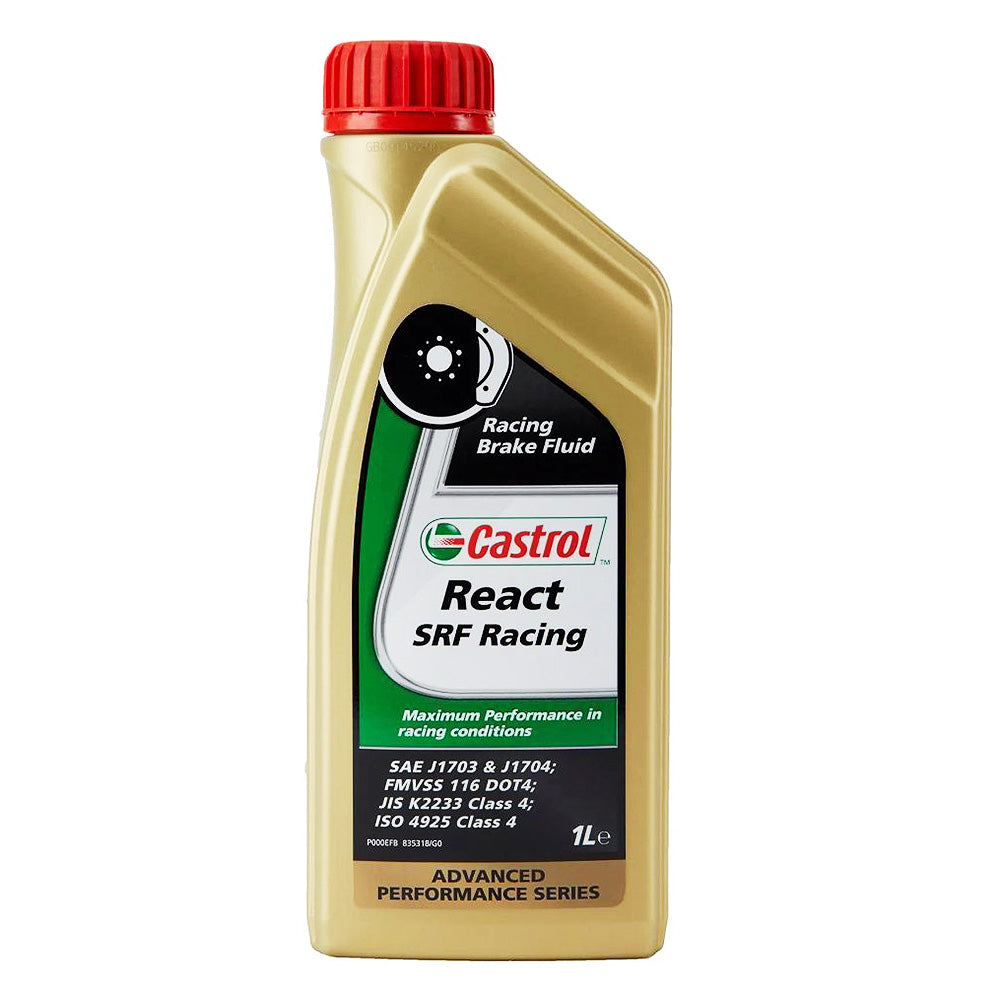
Castrol React SRF Synthetic Racing Brake Fluid (1000 ml)
from $145.00
Castrol React SRF Racing Brake Fluid
Ultra-High Wet Boiling Point Makes Castrol SRF A Standout
Castrol React SRF Racing Brake Fluid is an ultra-high performance brake fluid popular with many of the highest performing auto racing teams around the world. The key to Castrol SRF brake fluid's performance is its silicon-ester technology. Not only is it less hygroscopic (i.e., it absorbs less water) than typical glycol-based brake fluids, Castrol SRF also reacts chemically with any absorbed water to further reduce its adverse effects on high-temperature braking performance.
The result is an almost unheard of 518° F (270° C) wet boiling point, more than 100° F higher than most other racing brake fluids!
Exceeds SAE 1703, ISO 4925, JIS K2233, FMVSS No. 116 DOT3 and DOT 4 specifications.
Note: Castrol SRF is not a silicone-based brake fluid (i.e., DOT 5) and is compatible with most factory brake systems and fluids, including DOT 3 and DOT 4 fluids. Always follow vehicle manufacturer's recommendations when adding brake fluid.
Castrol React SRF Racing Brake Fluid Typical Properties:
Dry Boiling Point: 590°F (310°C)
Wet Boiling Point: 518°F (270°C)
Superior anti-vapor lock properties
One-liter (1000ml) bottle
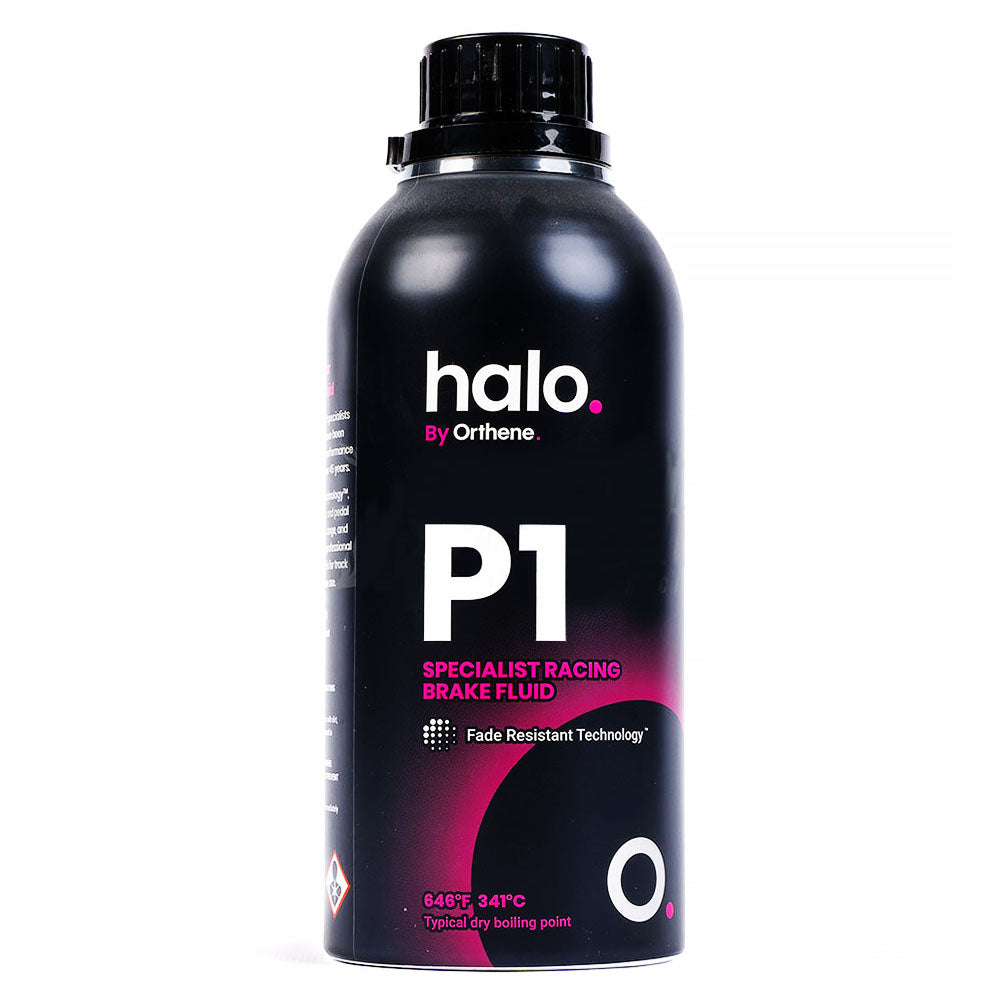
HALO P1 Advanced High Performance Brake Fluid (590 ml)
$109.00
HALO P1 High Performance Brake Fluid
The World's Most Advanced Racing Brake Fluid
Imagine you're on the race track, hitting the entry to a corner. Your foot hammers down on the brake, and you feel... absolute perfection. That's Halo P1 for you. Developed with Fade Resistant Technology, this specialist brake fluid is the secret sauce for top-tier motorsport enthusiasts worldwide.
Why? Because when you're tearing up the track, the last thing you want is a mushy pedal feel. Halo P1 delivers a low and stable compressibility profile over an extended temperature range, not to mention a crazy-high dry boiling point of 341º C (646º F). All of this is to ensure your brake pedal feel remains as strong and consistent as your lap times.Sold in 590 ml (20 fl. oz.) bottles.
Features & Benefits That'll Make You Weep Tears of Joy
Fade Resistant Technology: Keeps your pedal feel consistent, lap after lap, so you can focus on nailing those corners.
Pure Methyl Borate Ester Base: The purity level here is so high, it's like the distilled essence of speed itself, ensuring extreme resistance to compression, even when things get hot (and we mean really hot).
World-Beating Dry Boiling Point: At 341° C (646° F), it's like this fluid laughed in the face of boiling points and set a new standard.
Low Viscosity & High Lubricity: Because your brake system deserves to be as smooth as your driving skills.
What Makes Halo P1 The Secret Weapon?
While other brake fluids are off playing checkers, Halo P1 is mastering chess. It's not just another methyl glycol borate ester brake fluid; it's a revolution in braking performance. With its unique proprietary manufacturing process, it achieves the highest levels of purity and the lowest compressibility possible, remaining constant over a wide temperature range. This is the highest boiling point of any racing brake fluid on the market, folks. And the lubricity? Off the charts, especially at high temperatures.
FAQs That'll Clear the Air
Before you rush off to convert your entire garage to a Halo P1 shrine, let's tackle some of those burning questions you might have:
Can I use Halo P1 in my daily driver? As much as we love the enthusiasm, Halo P1 is a race-only formula. It's like putting a rocket booster on a bicycle – thrilling, but not recommended.
How often should I change my brake fluid with Halo P1? Regular maintenance is key in racing. Check with your team or mechanic, but before every major race is a good rule of thumb.
The Call to Action You've Been Waiting For
So, are you ready to elevate your racing game to legendary status? To feel the rush of confidence as you brake later and harder, knowing your brake fluid won't let you down? It's time to switch to Halo P1. Your podium awaits.