
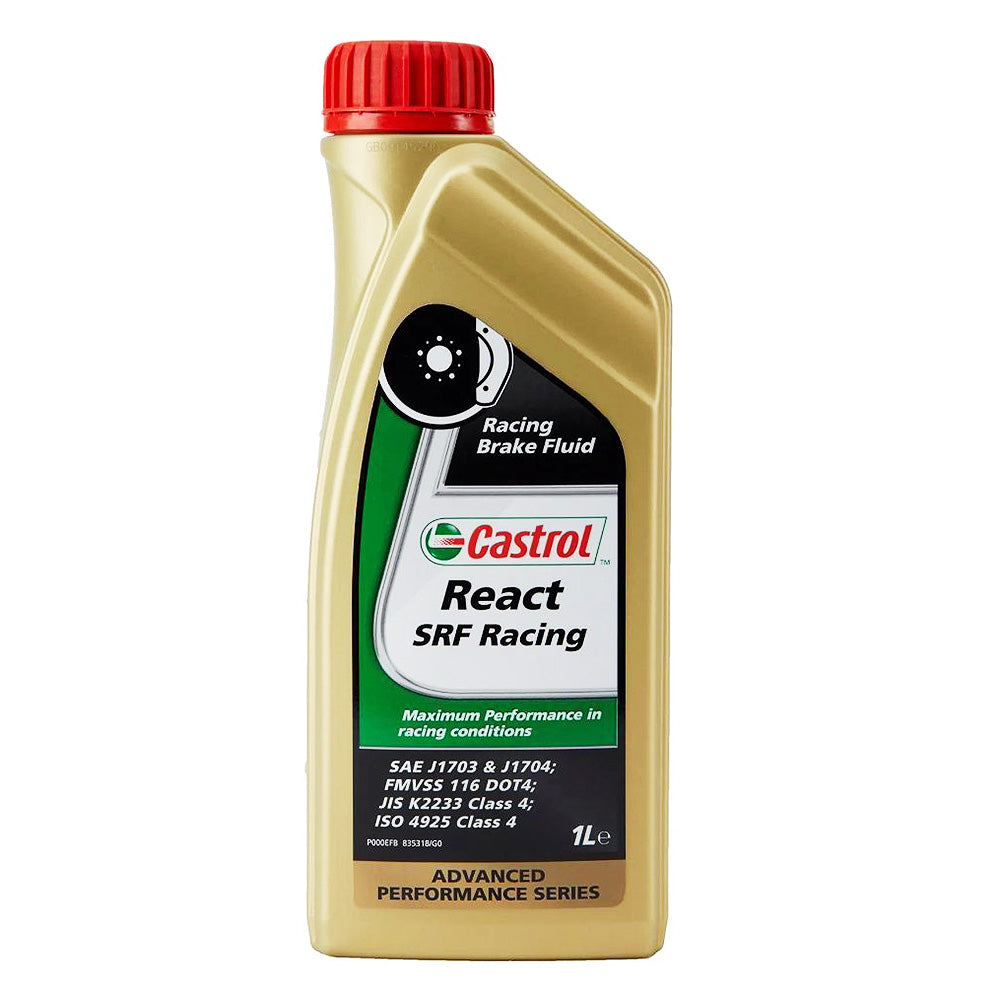
Castrol React SRF Synthetic Racing Brake Fluid (1000 ml)
from $146.00
Castrol React SRF Racing Brake Fluid
Ultra-High Wet Boiling Point Makes Castrol SRF A Standout
Castrol React SRF Racing Brake Fluid is an ultra-high performance brake fluid popular with many of the highest performing auto racing teams around the world. The key to Castrol SRF brake fluid's performance is its silicon-ester technology. Not only is it less hygroscopic (i.e., it absorbs less water) than typical glycol-based brake fluids, Castrol SRF also reacts chemically with any absorbed water to further reduce its adverse effects on high-temperature braking performance.
The result is an almost unheard of 518° F (270° C) wet boiling point, more than 100° F higher than most other racing brake fluids!
Exceeds SAE 1703, ISO 4925, JIS K2233, FMVSS No. 116 DOT3 and DOT 4 specifications.
Note: Castrol SRF is not a silicone-based brake fluid (i.e., DOT 5) and is compatible with most factory brake systems and fluids, including DOT 3 and DOT 4 fluids. Always follow vehicle manufacturer's recommendations when adding brake fluid.
Castrol React SRF Racing Brake Fluid Typical Properties:
Dry Boiling Point: 590°F (310°C)
Wet Boiling Point: 518°F (270°C)
Superior anti-vapor lock properties
One-liter (1000ml) bottle

Cobalt AP21 Brake Pads
$859.00
Cobalt AP21 Brake Pads
Cobalt AP21 Brake Pad Fitment Guide
Make
Model
Build (Year)
Front
Rear
McLaren
570S. 540C, 570GT
2015 +
X
McLaren
570S GT4 race car
2016 - 17
X
McLaren
650S / Spyder
2014 - 17
X
McLaren
675LT
2015 +
X
McLaren
MP4-12C
2011 - 14
X
McLaren
GT
2019 +
X
Cobalt AP21 Brake Pad Compounds

Cobalt AP7 Brake Pads (Rear)
$677.00
Cobalt AP7 Brake Pads
Cobalt AP7 Brake Pad Fitment Guide
Make
Model
Build (Year)
Front
Rear
McLaren
570S. 540C, 570GT
2015 +
X
McLaren
570S GT4 race car
2016 - 17
X
McLaren
570S GT4 [race car] (wider front caliper)
2018 +
X
McLaren
570 S GT4 [race car] Alcon front Calipers
2020 +
X
McLaren
650S / Spyder
2014 - 17
X
McLaren
675LT
2015 +
X
McLaren
MP4-12C
2011 - 14
X
McLaren
GT
2019 +
X
Cobalt AP7 Brake Pad Compounds

Ferodo FRP3083 Brake Pads (Front)
from $360.00
Ferodo FRP3083 Brake Pads
Ferodo FRP3083 Brake Pad Fitment Guide
Make
Model
Build (Year)
Front
Rear
Lotus
3-Eleven 430
15 -
X
X
Lotus
Evora 3.5 and 3.5S
09 - 16
X
Lotus
Evora 3.5 400
15 -
X
X
Lotus
Exige V6 Sport 350
16 -
X
McLaren
570S. 540C, 570 GT
15 -
X
McLaren
570S GT4 race car
16 - 17
X
McLaren
570S GT4 [race car] (wider front caliper)
18 -
X
McLaren
570 S GT4 [race car] Alcon front Calipers
20 -
X
McLaren
650S / Spyder
14 - 17
X
McLaren
675LT
15 -
X
McLaren
MP4-12C
11 - 14
X
Renault
Clio 3.0 V6 Turbo Sport
98 - 03
X
McLaren
GT
2019 -
X
Ferodo DS3.12 Brake Compound Details
The DS3.12 is the latest evolution in Ferodo's incredible DS line. Sports cars today have more of everything: more horsepower, more sophisticated aero, higher curb weights, and stickier tires. These attributes place serious demands on a vehicle's brake system. The Ferodo DS3.12 is the modern pad compound designed from the start to explicitly handle those demands.
The Ferodo DS3.12 is a top-tier endurance racing brake pad compound built for maximum fade resistance, high friction, and extremely consistent performance at elevated temperatures. If you need a Ferodo track brake pad for aggressive braking, long sessions, and serious motorsport use, DS3.12 is one of the strongest options in the lineup.
The DS3.12 compound provides strong initial bite, a highly stable torque curve, and dependable braking performance in demanding track conditions. It is ideal for experienced drivers, endurance racing, and high-grip applications where repeatable stopping power matters most.
Maximum fade resistance in the Ferodo range
High friction and strong initial bite
Very consistent braking response at track temperatures
Excellent durability in endurance racing use
Best for: advanced track-day drivers and racers who want a high-performance race brake pad with elite heat capacity and confidence-inspiring consistency.
Note: DS3.12 is a full race compound and may produce increased dust, disc wear, and reduced cold performance compared with street-oriented pads.
Ferodo DS1.11 Brake Compound Details
The DS1.11 has a lower mu than the DS3.12 at all temperatures and can be characterized as a moderate mu pad vs. other endurance racing compounds. They require more pedal force than the DS3.12, and they have a slightly declining torque curve as temperatures rise. As they get hotter and you dive deeper into a turn, you may feel like you need to push a little harder on the brake pedal to elicit the same response (which is a feel many drivers actually prefer). Some drivers feel that the DS1.11 is more controllable on street tires than DS3.12 since ABS cannot be activated as easily. It will last a fairly long time vs. many other pad compounds on the market but does not last quite as long as the DS3.12. They are very gentle on discs at track temperatures when a proper pad transfer layer is maintained. The DS1.11 also has an outstanding max temp and fade resistance, just not quite as high as 3.12. We're not aware of anyone who has faded them, and most people differentiate between the DS1.11 and DS3.12 based on feel.
The Ferodo DS1.11 is a proven endurance racing brake pad compound designed for drivers who need outstanding fade resistance, long pad life, and precise control under repeated high-temperature braking. For track cars and serious HPDE builds, DS1.11 is a trusted Ferodo race brake pad with a strong reputation for consistency.
This DS1.11 features stable braking performance, excellent modulation, and durability in demanding track conditions. Compared with more street-focused compounds, DS1.11 is better suited to aggressive lapping, endurance sessions, and drivers who value a progressive pedal feel.
Exceptional fade resistance for track use
Long wear characteristics in endurance-style driving
Progressive, controllable pedal feel
Excellent choice for HPDE and racing applications
Best for: drivers looking for a track brake pad with durability, modulation, and high-temperature stability for repeated hard use.
Note: DS1.11 is a race compound and is not ideal for customers seeking low noise, low dust, or refined street manners.
Ferodo DSUNO Brake Compound Details
For our customers who enjoy the performance of the DS1.11, but just want a little more bite, we recommend the DSUNO. It doesn't wear quite as long as the DS1.11, but it does offer a higher overall mu once it reaches track temperatures.
Ferodo DS2500 Compound Details
Although we always recommend using a dedicated race pad for the track, the DS2500 is one of the best hybrid street/track pads on the market. It features the moderately high bite and solid fade resistance of a track pad, with the relatively low dust and noise levels of a street pad. When used as a street pad, it can produce some squeal on certain vehicle platforms. If you drive aggressively on the street, do some canyon runs, autocross, and maybe some light track duty on street tires, the DS2500 is tough to beat.
The Ferodo DS2500 is one of the most popular performance brake pad compounds for drivers who want strong braking on the street and dependable performance at the track. If you are looking for a street and track brake pad with excellent cold bite, low noise, and impressive fade resistance, the DS2500 is a proven choice.
The DS2500 delivers confident pedal feel, consistent stopping power, and better high-temperature performance than typical street pads. It is an excellent option for spirited driving, autocross, HPDE, and dual-purpose performance cars.
Strong cold bite for street use
Low noise when properly bedded
Excellent fade resistance for a dual-purpose pad
Great match for performance street tires
Best for: drivers who want a versatile Ferodo brake pad for daily driving, canyon runs, and light to moderate track use without giving up refinement.
Note: DS2500 is a race-derived compound and may produce more dust than an ordinary OEM street pad.
Ferodo DS3000 Brake Compound Details
The predecessor to DS1.11, DS3000 offers high initial bite with excellent feel and release. Popular among rally teams, DS3000 has a relatively low cold temperature threshold while still offering high temp stability for tarmac. DS3000 is very easy on discs at the expense of pad wear.
Ferodo FRP3083 Comparison Chart
Out of all the pad compounds we've ever tested, from all manufacturers, the Ferodo DS3.12 shows the flattest torque curve across the broadest temperature range. That means on every turn, on every track you drive, on every lap, your brake pedal is going to feel almost exactly the same, providing tremendous consistency and repeatability. The DS3.12 has a higher mu (µ) than Ferodo's other compounds, so not as much pedal pressure is required to initiate the desired response. It is also un-fadable, showing no drop in performance at any temperature your brakes will ever see.
Ferodo FRP3083 Coefficient of Friction (Mu) Comparison Chart
In dyno testing, the Ferodo DS3.12 has shown superior wear rates to the other Ferodo compounds, while remaining kind to brake rotors. We believe the Ferodo DS3.12 will become the gold standard by which other race compounds will be judged.
Ferodo FRP3083 Operating Temperature Comparison Chart
**Designed for use with iron brake rotors only. Not for use with carbon-ceramic rotors.**
Ferodo FRP3115 Brake Pads
from $357.00
Ferodo FRP3115 Brake Pads
Ferodo FRP3115 Brake Pad Fitment Guide
Make
Model
Build (Year)
Front
Rear
Lotus
Evora 3.5 and 3.5S
09 - 16
X
Lotus
Exige V6 Sport 350
16 -
X
Ferodo DS3.12 Brake Compound Details
The DS3.12 is the latest evolution in Ferodo's incredible DS line. Sports cars today have more of everything: more horsepower, more sophisticated aero, higher curb weights, and stickier tires. These attributes place serious demands on a vehicle's brake system. The Ferodo DS3.12 is the modern pad compound designed from the start to explicitly handle those demands.
The Ferodo DS3.12 is a top-tier endurance racing brake pad compound built for maximum fade resistance, high friction, and extremely consistent performance at elevated temperatures. If you need a Ferodo track brake pad for aggressive braking, long sessions, and serious motorsport use, DS3.12 is one of the strongest options in the lineup.
The DS3.12 compound provides strong initial bite, a highly stable torque curve, and dependable braking performance in demanding track conditions. It is ideal for experienced drivers, endurance racing, and high-grip applications where repeatable stopping power matters most.
Maximum fade resistance in the Ferodo range
High friction and strong initial bite
Very consistent braking response at track temperatures
Excellent durability in endurance racing use
Best for: advanced track-day drivers and racers who want a high-performance race brake pad with elite heat capacity and confidence-inspiring consistency.
Note: DS3.12 is a full race compound and may produce increased dust, disc wear, and reduced cold performance compared with street-oriented pads.
Ferodo DS1.11 Brake Compound Details
The DS1.11 has a lower mu than the DS3.12 at all temperatures and can be characterized as a moderate mu pad vs. other endurance racing compounds. They require more pedal force than the DS3.12, and they have a slightly declining torque curve as temperatures rise. As they get hotter and you dive deeper into a turn, you may feel like you need to push a little harder on the brake pedal to elicit the same response (which is a feel many drivers actually prefer). Some drivers feel that the DS1.11 is more controllable on street tires than DS3.12 since ABS cannot be activated as easily. It will last a fairly long time vs. many other pad compounds on the market but does not last quite as long as the DS3.12. They are very gentle on discs at track temperatures when a proper pad transfer layer is maintained. The DS1.11 also has an outstanding max temp and fade resistance, just not quite as high as 3.12. We're not aware of anyone who has faded them, and most people differentiate between the DS1.11 and DS3.12 based on feel.
The Ferodo DS1.11 is a proven endurance racing brake pad compound designed for drivers who need outstanding fade resistance, long pad life, and precise control under repeated high-temperature braking. For track cars and serious HPDE builds, DS1.11 is a trusted Ferodo race brake pad with a strong reputation for consistency.
This DS1.11 features stable braking performance, excellent modulation, and durability in demanding track conditions. Compared with more street-focused compounds, DS1.11 is better suited to aggressive lapping, endurance sessions, and drivers who value a progressive pedal feel.
Exceptional fade resistance for track use
Long wear characteristics in endurance-style driving
Progressive, controllable pedal feel
Excellent choice for HPDE and racing applications
Best for: drivers looking for a track brake pad with durability, modulation, and high-temperature stability for repeated hard use.
Note: DS1.11 is a race compound and is not ideal for customers seeking low noise, low dust, or refined street manners.
Ferodo DS2500 Compound Details
Although we always recommend using a dedicated race pad for the track, the DS2500 is one of the best hybrid street/track pads on the market. It features the moderately high bite and solid fade resistance of a track pad, with the relatively low dust and noise levels of a street pad. When used as a street pad, it can produce some squeal on certain vehicle platforms. If you drive aggressively on the street, do some canyon runs, autocross, and maybe some light track duty on street tires, the DS2500 is tough to beat.
The Ferodo DS2500 is one of the most popular performance brake pad compounds for drivers who want strong braking on the street and dependable performance at the track. If you are looking for a street and track brake pad with excellent cold bite, low noise, and impressive fade resistance, the DS2500 is a proven choice.
The DS2500 delivers confident pedal feel, consistent stopping power, and better high-temperature performance than typical street pads. It is an excellent option for spirited driving, autocross, HPDE, and dual-purpose performance cars.
Strong cold bite for street use
Low noise when properly bedded
Excellent fade resistance for a dual-purpose pad
Great match for performance street tires
Best for: drivers who want a versatile Ferodo brake pad for daily driving, canyon runs, and light to moderate track use without giving up refinement.
Note: DS2500 is a race-derived compound and may produce more dust than an ordinary OEM street pad.
Ferodo DS3000 Brake Compound Details
The predecessor to DS1.11, DS3000 offers high initial bite with excellent feel and release. Popular among rally teams, DS3000 has a relatively low cold temperature threshold while still offering high temp stability for tarmac. DS3000 is very easy on discs at the expense of pad wear.
Ferodo FRP3115 Comparison Chart
Out of all the pad compounds we've ever tested, from all manufacturers, the Ferodo DS3.12 shows the flattest torque curve across the broadest temperature range. That means on every turn, on every track you drive, on every lap, your brake pedal is going to feel almost exactly the same, providing tremendous consistency and repeatability. The DS3.12 has a higher mu (µ) than Ferodo's other compounds, so not as much pedal pressure is required to initiate the desired response. It is also un-fadable, showing no drop in performance at any temperature your brakes will ever see.
Ferodo FRP3115 Coefficient of Friction (Mu) Comparison Chart
In dyno testing, the Ferodo DS3.12 has shown superior wear rates to the other Ferodo compounds, while remaining kind to brake rotors. We believe the Ferodo DS3.12 will become the gold standard by which other race compounds will be judged.
Ferodo FRP3115 Operating Temperature Comparison Chart
**Designed for use with iron brake rotors only. Not for use with carbon-ceramic rotors.**
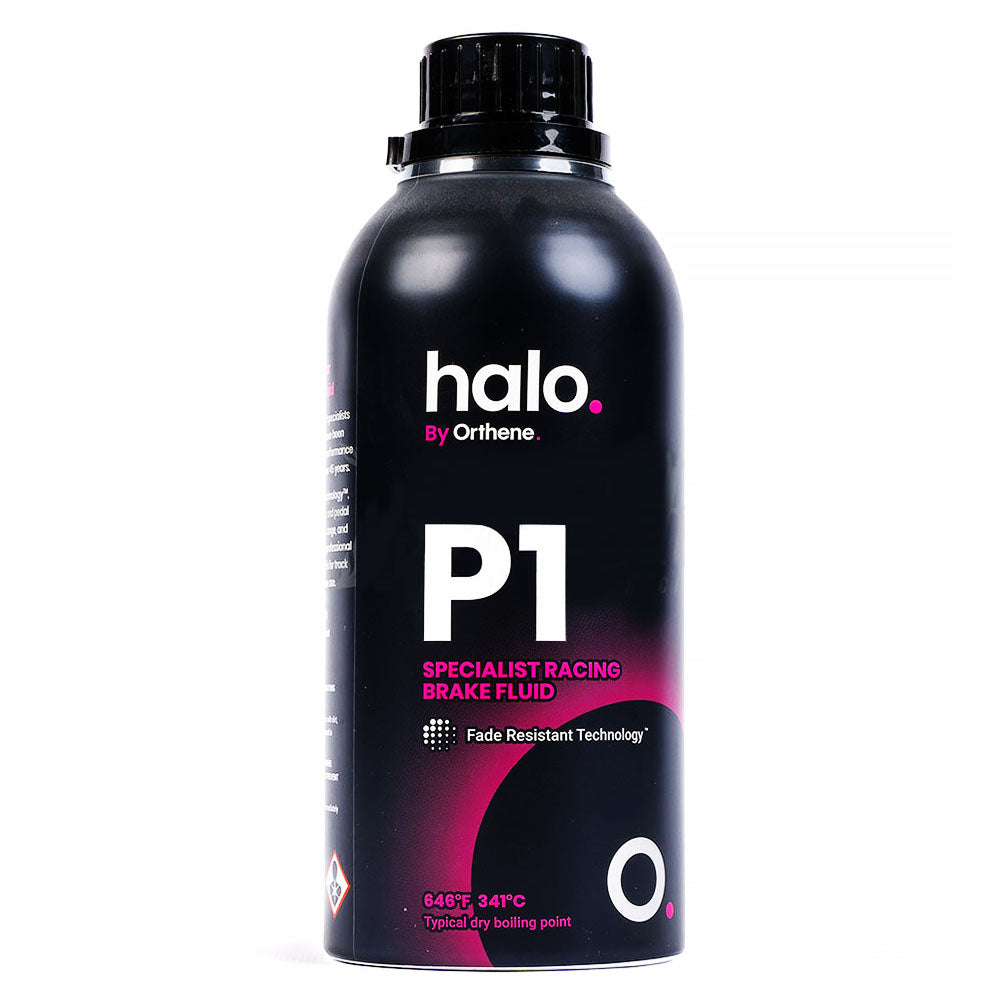
HALO P1 Advanced High Performance Brake Fluid (590 ml)
$110.00
HALO P1 High Performance Brake Fluid
The World's Most Advanced Racing Brake Fluid
Imagine you're on the race track, hitting the entry to a corner. Your foot hammers down on the brake, and you feel... absolute perfection. That's Halo P1 for you. Developed with Fade Resistant Technology, this specialist brake fluid is the secret sauce for top-tier motorsport enthusiasts worldwide.
Why? Because when you're tearing up the track, the last thing you want is a mushy pedal feel. Halo P1 delivers a low and stable compressibility profile over an extended temperature range, not to mention a crazy-high dry boiling point of 341º C (646º F). All of this is to ensure your brake pedal feel remains as strong and consistent as your lap times.Sold in 590 ml (20 fl. oz.) bottles.
Features & Benefits That'll Make You Weep Tears of Joy
Fade Resistant Technology: Keeps your pedal feel consistent, lap after lap, so you can focus on nailing those corners.
Pure Methyl Borate Ester Base: The purity level here is so high, it's like the distilled essence of speed itself, ensuring extreme resistance to compression, even when things get hot (and we mean really hot).
World-Beating Dry Boiling Point: At 341° C (646° F), it's like this fluid laughed in the face of boiling points and set a new standard.
Low Viscosity & High Lubricity: Because your brake system deserves to be as smooth as your driving skills.
What Makes Halo P1 The Secret Weapon?
While other brake fluids are off playing checkers, Halo P1 is mastering chess. It's not just another methyl glycol borate ester brake fluid; it's a revolution in braking performance. With its unique proprietary manufacturing process, it achieves the highest levels of purity and the lowest compressibility possible, remaining constant over a wide temperature range. This is the highest boiling point of any racing brake fluid on the market, folks. And the lubricity? Off the charts, especially at high temperatures.
FAQs That'll Clear the Air
Before you rush off to convert your entire garage to a Halo P1 shrine, let's tackle some of those burning questions you might have:
Can I use Halo P1 in my daily driver? As much as we love the enthusiasm, Halo P1 is a race-only formula. It's like putting a rocket booster on a bicycle – thrilling, but not recommended.
How often should I change my brake fluid with Halo P1? Regular maintenance is key in racing. Check with your team or mechanic, but before every major race is a good rule of thumb.
The Call to Action You've Been Waiting For
So, are you ready to elevate your racing game to legendary status? To feel the rush of confidence as you brake later and harder, knowing your brake fluid won't let you down? It's time to switch to Halo P1. Your podium awaits.
Pagid 4345 Racing Brake Pads (Front)
from $561.00
Pagid Racing Brake Pad Shape 4345
Pagid 4345 Brake Pad Fitment Guide
Make
Model
Build (Year)
Front
Rear
Lotus
3-Eleven 430
15 -
X
X
Lotus
Evora 3.5 and 3.5S
09 - 16
X
Lotus
Evora 3.5 400
15 -
X
X
Lotus
Exige V6 Sport 350
16 -
X
McLaren
570S. 540C, 570 GT
15 -
X
McLaren
570S GT4 race car
16 - 17
X
McLaren
570S GT4 [race car] (wider front caliper)
18 -
X
McLaren
570 S GT4 [race car] Alcon front Calipers
20 -
X
McLaren
650S / Spyder
14 - 17
X
McLaren
675LT
15 -
X
McLaren
MP4-12C
11 - 14
X
Renault
Clio 3.0 V6 Turbo Sport
98 - 03
X
McLaren
GT
2019 -
X
Pagid Racing Brake Pads are engineered for high-performance driving, delivering exceptional stopping power, durability, and control under the most demanding conditions. Trusted by professional racers and performance enthusiasts worldwide, these pads are crafted using advanced friction materials and cutting-edge technology to ensure consistent performance, low fade, and excellent modulation. Whether you're on the track or tackling aggressive street driving, Pagid Racing Brake Pads provide the reliability and confidence you need to push your vehicle to its limits.
Pagid Racing Brake compounds are for steel (cast iron) rotors only unless otherwise noted.
RSL 29 Compound:
The Pagid RSL 29 (Yellow) is the world-leading endurance brake pad used by most of the winning teams in motorsport. Although designed primarily for endurance racing, many competitors use this material successfully for sprint and short distance races also. RS29 has also found favor in the growing track day market due to the level of control, good cold performance, long life and low disc wear.
Pagid RSL 1 Compound
Used in GT cars, touring cars and prototype endurance racing. Due to the high friction and good modulation, often used in sprint races as well. RSL 1 is a low metallic resin bonded material containing steel and aramid fibers with very high heat resistance. It maintains a constant friction level over a wide range of temperatures. Its reduced wear rate and disc friendliness make this material appropriate for endurance races.
Pagid RSL 2 Compound:
RSL 2 is a low metallic resin bonded material containing steel and aramid fibers with high heat resistance. It maintains a constant friction level over a wide range of temperatures. Its reduced wear rate and disc friendliness make this material appropriate for endurance races on applications with high cooling efficiency. RSL 2 features excellent pad life and modulation, as well as friction stability at high temperatures.
Pagid RST 1 Compound
Used in Rally tarmac, GT cars and touring cars circuit racing (sprint), high down-force formula cars, NASCAR. Suitable for applications in heavy cars and where high torque is necessary against small diameter rotors. RST 1 has a very high friction level and high temperature resistance. It is a semi-metallic resin bonded material containing steel fibers. Cold friction and initial bite makes this material most appropriate for Rally and NASCAR applications.
Pagid RST 2 Compound
The Pagid RST 2 Racing Brake Pads are a medium to high-friction pad designed for Rally, Sprint and Stock car racing. With aggressive in-stop behavior, instant pedal engagement, and a consistently firm feel regardless of temperature, the RST-2 gives maximum power regardless of the conditions. Excellent initial bite with excellent modulation and release characteristics. The medium torque Pagid RST-2 pads are fade resistant up to 800°C, and have the lowest thermal conductivity in the RST line
Pagid RST 3 Compound:
RST 3 is a medium-high friction metal-ceramic compound containing steel fibers and is therefore the perfect complement of the RST product family. It captivates by its low heat conductivity. Rally tarmac and gravel, GT cars, touring cars and prototype circuit racing, formula cars and club racing. Wide range of applications due to it‘s combination of bite, friction and controllability.
Pagid RST 4 Compound:
RST 4 is a semi-metallic resin bonded material containing steel fibers. This material has a medium friction level and high temperature resistance. Typically use is in formula cars and open wheel racing. It is also very popular as a rear-axle material for rally racing (tarmac and gravel) and for front engine cars. Also used in NASCAR on long ovals.
Pagid 8214 Racing Brake Pads
$583.00
Pagid Racing Brake Pad Shape 8214
Pagid 8214 Brake Pad Fitment Guide
Make
Model
Build (Year)
Front
Rear
Lotus
Evora 3.5
2010 - 15
X
Lotus
Evora 3.5 S (supercharged)
2010 - 14
X
Lotus
Exige V6 Sport 350
2016 - 19
X
Fits the Following Calipers:
Make
Type
Remarks
Shape No.
AP Racing
CP6627 D51
16.7 mm
8214
Pagid Racing Brake Pads are engineered for high-performance driving, delivering exceptional stopping power, durability, and control under the most demanding conditions. Trusted by professional racers and performance enthusiasts worldwide, these pads are crafted using advanced friction materials and cutting-edge technology to ensure consistent performance, low fade, and excellent modulation. Whether you're on the track or tackling aggressive street driving, Pagid Racing Brake Pads provide the reliability and confidence you need to push your vehicle to its limits.
Pagid Racing Brake compounds are for steel (cast iron) rotors only unless otherwise noted.
Pagid RSL 29 Compound
The Pagid RSL 29 (Yellow) is the world-leading endurance brake pad used by most of the winning teams in motorsport. Although designed primarily for endurance racing, many competitors use this material successfully for sprint and short distance races also. RS29 has also found favor in the growing track day market due to the level of control, good cold performance, long life and low disc wear.
Performance Friction PFC 7869 Brake Pads (Front)
from $487.00
Performance Friction PFC 7869 Brake pad
Performance Friction PFC 7869 Brake Pad Fitment Guide
Make
Model
Engine
Year
Notes
F/R
Lotus
Evora
3.5 liter
2009-
GTS AP 4-piston (17mm)
Front
Lotus
Exige
V6
Front
McLaren
570S
GT4
Front
McLaren
MP4-12C
(17mm)
Rear
PFC Brakes offers a wide range of sports car applications. Each PFC product is meticulously created to the highest performance and technology expectations. For PFC, we take pride in the accomplishments of the
Performance Friction Brake Compound Performance
The Performance Friction PFC 7869 racing brake pad delivers competition-focused braking performance for drivers who demand consistent stopping power, precise modulation, and dependable operation under demanding track conditions. Featuring a 130 mm overall width, 55 mm friction material depth, and 17 mm friction material thickness excluding the backing plate, the PFC 7869 is designed for compatible high-performance brake calipers requiring this distinctive pad shape.
Available from Competition Motorsport in PFC 08 and PFC 332 racing compounds, the 7869 allows drivers to choose between endurance-focused braking characteristics and degressive friction technology developed for rear-axle applications and ABS compatibility.
The PFC 7869 is also a recognized pad shape cross-reference for Pagid Racing 4345, making it a potential alternative for drivers looking to change friction compounds while retaining compatible brake caliper geometry. Always verify pad thickness and fitment before ordering.
PFC 7869 Brake Pad Specifications
Manufacturer: Performance Friction (PFC)
Pad Shape: 7869
Overall Width: 130 mm
Friction Material Depth: 55 mm
Friction Material Thickness: 17 mm (excluding backing plate)
Available Compounds: PFC 08 and PFC 332
Pagid Racing Shape Cross-Reference: 4345
Intended Use: Compatible motorsport and high-performance brake calipers
The PFC 7869 features a distinctive backing plate with two upper retaining holes, a prominent raised central mounting section, and a curved friction surface divided by a central groove. Its specialized geometry makes accurate pad identification essential when replacing existing racing brake pads.
PFC 08 Racing Compound – Endurance Performance and Consistent Modulation
Performance Friction Compound 08 is a proven endurance racing friction material designed for consistent braking response during extended periods of demanding track use. Known for its progressive initial bite, predictable modulation, and favorable wear characteristics, PFC 08 is an excellent choice for drivers seeking dependable braking performance throughout long racing sessions.
Compound 08 features friction characteristics that increase as operating temperature rises while maintaining favorable wear performance at elevated temperatures. This makes it particularly attractive for endurance racing, club racing, and advanced track-day applications where consistent braking behavior and durability are essential.
Benefits of PFC 08 Compound
Endurance Racing Performance: Developed for extended motorsport competition.
Progressive Initial Bite: Predictable braking response for precise driver control.
Excellent Modulation: Smooth, controllable braking characteristics.
Temperature-Responsive Friction: Friction increases with operating temperature.
Favorable Wear Characteristics: Designed for reduced wear during high-temperature operation.
PFC 332 Racing Compound – Degressive Rear Brake Performance and ABS Compatibility
Performance Friction Compound 332 is a degressive racing brake friction material developed primarily for rear-axle applications. Engineered to support modern racing ABS systems, PFC 332 emphasizes controlled brake torque, predictable braking response, and favorable pad and rotor wear characteristics.
Its degressive friction behavior helps manage brake torque as operating conditions change, making Compound 332 particularly attractive for competition vehicles where rear brake stability, front-to-rear brake balance, and ABS interaction are important.
PFC 332 is designed for demanding racing environments where consistent rear braking behavior and controlled deceleration are priorities.
Benefits of PFC 332 Compound
Rear-Axle Focused: Developed for compatible rear racing brake applications.
ABS-Friendly Friction: Degressive friction characteristics designed to support racing ABS operation.
Controlled Brake Torque: Helps provide predictable rear braking behavior.
Low Wear Characteristics: Designed for favorable pad and brake disc wear.
Competition-Oriented Performance: Developed for demanding motorsport braking systems.
PFC 08 vs. PFC 332 – Which Racing Brake Compound Should You Choose?
Although both PFC 08 and PFC 332 are designed for motorsport use, they offer distinctly different braking characteristics.
PFC 08: Endurance-focused racing compound emphasizing progressive initial bite, consistent modulation, and favorable wear characteristics during extended track use.
PFC 332: Degressive racing compound developed for rear-axle applications, emphasizing controlled brake torque, ABS compatibility, and low wear.
For drivers prioritizing endurance performance and progressive braking response, PFC 08 is an excellent choice. For compatible rear brake applications where ABS interaction and controlled brake torque are important, PFC 332 may be the preferred option.
The ideal compound depends on vehicle weight, tire grip, brake balance, ABS calibration, rotor configuration, operating temperatures, and driving style.
PFC 7869 and Pagid 4345 Brake Pad Cross-Reference
The Performance Friction 7869 pad shape is a recognized cross-reference for the Pagid Racing 4345 backing plate profile. This makes PFC 7869 worth considering when replacing Pagid 4345 racing brake pads or evaluating alternative friction materials for a compatible braking system.
However, a matching pad shape does not automatically guarantee interchangeability. Confirm backing plate dimensions, mounting-hole geometry, friction material thickness, and complete assembled pad thickness before installation.
Why Choose Performance Friction PFC 7869 Brake Pads?
Performance Friction has established a strong reputation in professional motorsport through the development of advanced racing brake friction materials and braking systems. The PFC 7869 combines specialized backing plate geometry with two competition-focused compounds for different braking requirements.
Precision PFC 7869 backing plate geometry
130 mm overall width
55 mm friction material depth
17 mm friction material thickness
Available in PFC 08 and PFC 332 compounds
Recognized Pagid Racing 4345 shape cross-reference
Designed for compatible high-performance brake calipers
PFC 7869 Brake Pad Fitment and Compatibility
The Performance Friction 7869 brake pad is intended for calipers requiring its specific backing plate profile, retaining-hole locations, friction surface geometry, and pad thickness.
Before ordering, compare your existing pads with the PFC 7869 technical drawing. Confirm the 130 mm overall width, 55 mm friction material depth, 17 mm friction material thickness, and mounting geometry.
The 17 mm thickness measurement refers exclusively to the friction material and excludes the steel backing plate. It should not be confused with the complete assembled pad thickness.
Vehicle make and model alone may not establish compatibility, particularly when aftermarket racing calipers or optional performance brake packages are installed.
Frequently Asked Questions About PFC 7869 Brake Pads
What compounds are available for PFC 7869 brake pads?
Competition Motorsport offers the Performance Friction 7869 pad shape in PFC 08 and PFC 332 racing compounds.
Is PFC 7869 the same shape as Pagid 4345?
PFC 7869 is a recognized shape cross-reference for Pagid Racing 4345. However, complete interchangeability depends on matching backing plate geometry, mounting features, and pad thickness.
What is the difference between PFC 08 and PFC 332?
PFC 08 is an endurance-focused racing compound emphasizing progressive modulation and favorable wear characteristics. PFC 332 is a degressive compound developed for rear-axle applications, with an emphasis on ABS compatibility and controlled brake torque.
Are PFC 7869 brake pads suitable for endurance racing?
Yes, when the pad shape is compatible with the vehicle's brake calipers and the selected compound matches the braking requirements. PFC 08 is particularly well suited to endurance racing applications.
Does the 17 mm thickness include the backing plate?
No. The specified 17 mm thickness refers to the friction material only. The steel backing plate is excluded.
Can PFC 7869 racing brake pads be used on the street?
PFC 08 and PFC 332 are competition-oriented friction materials primarily intended for motorsport use. Racing brake pads may produce additional noise and dust and may not provide ideal braking characteristics at normal street operating temperatures.
How do I confirm PFC 7869 brake pad fitment?
Compare the PFC 7869 technical drawing with your existing pads. Verify the 130 mm overall width, 55 mm friction material depth, 17 mm friction material thickness, retaining-hole locations, and backing plate geometry.
Buy PFC 7869 Racing Brake Pads at Competition Motorsport
Competition Motorsport specializes in Performance Friction racing brake pads, high-performance braking components, and professional motorsport equipment for HPDE enthusiasts, track-day drivers, club racers, and professional race teams.
Select your preferred PFC 7869 compound, 08 or 332, above. If you need assistance confirming Pagid 4345 cross-reference compatibility or selecting the correct racing brake compound, contact our motorsports specialists before ordering.
Performance Friction PFC 7870 Brake Pads
$502.00
Performance Friction PFC 7870 Brake Pads
Performance Friction PFC 7870 Brake Pads Fitment Guide
Make
Model
Build (Year)
Front
Rear
Lotus
Evora 3.5
2010 - 15
X
Lotus
Evora 3.5 S (supercharged)
2010 - 14
X
Lotus
Exige V6 Sport 350
2016 - 19
X
Fits the Following Calipers
Make
Type
Remarks
Shape No.
AP Racing
CP6627 D51
16.7 mm
8214
Performance Friction PFC 7870 Brake Pad Compounds and Performance
The Performance Friction PFC 7870 racing brake pad combines specialized backing plate geometry with the endurance-focused braking characteristics of PFC Compound 08. Designed for compatible high-performance and motorsport brake calipers, the PFC 7870 features a 130 mm overall width, 51 mm friction material depth, and 16 mm specified pad thickness.
Available from Competition Motorsport in PFC 08 racing compound, the 7870 is an excellent option for drivers seeking smooth initial bite, precise modulation, and consistent braking performance during demanding track sessions and endurance racing competition. Its combination of predictable brake response and favorable wear characteristics makes it particularly attractive for drivers who prioritize confidence and durability under repeated heavy braking.
The PFC 7870 is also a documented brake pad shape cross-reference for Pagid Racing 8214 and is associated with the same general caliper application as Ferodo FRP3115. These cross-references make the PFC 7870 worth considering when evaluating alternative racing brake compounds, although complete fitment and thickness must be verified before ordering.
PFC 7870 Brake Pad Specifications
Manufacturer: Performance Friction (PFC)
Pad Shape: 7870
Overall Width: 130 mm
Friction Material Depth: 51 mm
Specified Pad Thickness: 16 mm
Available Compound: PFC 08
Compound Type: Endurance racing friction material
Pagid Racing Shape Cross-Reference: 8214
Ferodo Related Shape: FRP3115
Associated Caliper Application: AP Racing CP6627 (verify exact configuration)
The PFC 7870 features a distinctive backing plate with two upper retaining holes, a prominent raised central mounting section, and a curved friction surface divided by a central groove. Its specialized geometry makes accurate pad shape identification essential when replacing existing racing brake pads or selecting alternative friction materials.
PFC 08 Racing Compound – Endurance Performance and Low Wear
Performance Friction Compound 08 is a proven endurance racing friction material developed to provide consistent braking characteristics during extended periods of demanding track use. Known for its smooth initial bite, excellent modulation, and favorable pad and rotor wear characteristics, PFC 08 is particularly attractive to drivers seeking predictable braking response throughout long racing sessions.
Compound 08 features friction characteristics that increase as operating temperature rises while maintaining low wear at elevated temperatures. This combination of durability, temperature-responsive friction, and controlled braking behavior makes PFC 08 an excellent choice for endurance racing, club racing, and advanced track applications.
Benefits of PFC 08 Racing Brake Compound
Endurance Racing Performance: Developed for demanding long-distance motorsport competition.
Smooth Initial Bite: Predictable braking engagement that supports precise driver control.
Excellent Modulation: Controlled braking response for managing deceleration and brake release.
Temperature-Responsive Friction: Friction increases as operating temperature rises.
Low Disc Wear: Designed for favorable brake rotor wear characteristics.
Consistent Braking Performance: Engineered for repeated heavy braking during extended racing sessions.
PFC 7870 and Pagid 8214 Brake Pad Cross-Reference
The Performance Friction 7870 pad shape is a documented cross-reference for Pagid Racing 8214. Both pad shapes are associated with compatible motorsport brake caliper applications, making PFC 7870 a potential alternative for drivers seeking Performance Friction racing compounds.
However, a matching pad shape does not automatically guarantee direct interchangeability. Brake pad thickness, backing plate geometry, mounting-hole locations, and caliper clearance must all be verified.
Ferodo FRP3115 is another related brake pad shape associated with the Pagid 8214 and AP Racing CP6627 application. Drivers comparing these alternatives should confirm the specific dimensions and thickness requirements before selecting a replacement.
Why Choose Performance Friction PFC 7870 Brake Pads?
Performance Friction has established a strong reputation in professional motorsport through the development of advanced racing brake friction materials and complete braking systems. The PFC 7870 combines specialized backing plate geometry with Compound 08's endurance-focused friction characteristics.
Precision PFC 7870 backing plate geometry
130 mm overall width
51 mm friction material depth
16 mm specified pad thickness
PFC 08 endurance racing compound
Recognized Pagid Racing 8214 shape cross-reference
Designed for compatible motorsport brake calipers
PFC 7870 Brake Pad Fitment and Compatibility
The Performance Friction 7870 brake pad is intended for calipers requiring its specific backing plate geometry, retaining-hole locations, friction surface profile, and pad thickness.
Before ordering, compare your existing pads with the PFC 7870 technical drawing. Confirm the 130 mm overall width, 51 mm friction material depth, 16 mm specified thickness, and mounting geometry.
Pay particular attention to whether the thickness specified by your brake caliper manufacturer refers to the friction material alone or the complete assembled brake pad, including the backing plate. These measurements are not interchangeable.
Vehicle make and model alone may not establish compatibility, particularly when aftermarket racing calipers or optional performance brake packages are installed.
Frequently Asked Questions About PFC 7870 Brake Pads
What compound is available for PFC 7870 brake pads?
Competition Motorsport offers the Performance Friction 7870 pad shape in PFC Compound 08, an endurance-focused racing friction material.
What are the benefits of PFC Compound 08?
PFC 08 offers smooth initial bite, excellent modulation, favorable wear characteristics, and consistent braking performance during demanding endurance racing applications.
Are PFC 7870 brake pads suitable for endurance racing?
Yes, when the pad shape is compatible with the vehicle's brake calipers and the selected compound matches the braking requirements. PFC 08 is specifically developed for endurance racing applications.
Does the 16 mm thickness include the backing plate?
The 16 mm thickness is the specified dimension for this listing. Confirm whether it refers to friction material thickness or complete assembled pad thickness against the exact PFC part number before ordering.
Can PFC 7870 racing brake pads be used on the street?
PFC 08 is a competition-oriented friction material primarily intended for motorsport use. Racing brake pads may produce additional noise and dust and may not provide ideal braking characteristics at normal street operating temperatures.
Buy PFC 7870 Racing Brake Pads at Competition Motorsport
Competition Motorsport specializes in Performance Friction racing brake pads, high-performance braking components, and professional motorsport equipment for HPDE enthusiasts, track-day drivers, club racers, and professional race teams.
Order PFC 7870 brake pads in Compound 08 for your compatible braking system, or contact our motorsports specialists for assistance confirming Pagid 8214 cross-reference compatibility and selecting the appropriate racing brake components for your application.