



AP Racing Limited
AP Racing 380mmx32mm 2-piece J Hook Front Brake Rotors for Porsche 991 GT3 Cup Car
$2,599.00
AP Racing 380x32mm 2-piece J Hook Front Floating Racing Brake Rotors
Fit The Following Cars (w/ OEM Iron Rotors)
Porsche 991 GT3 Cup Car (Front)
AP Racing by Essex 2-piece Competition J Hook front disc pair for 991 GT3 Cup Car
380mm x 32mm (14.96" x 1.26") 72 Vane, D66
Huge increase in airflow, cooling capacity, and durability vs. OEM discs
Saves 2 lbs. unsprung weight per side vs. OEM iron discs
Designed for: club racing, time trial, auto-x, HPDE
Works with OEM calipers, no modifications required
Ultralight, fully floating, anodized billet aluminum hat with float control/anti-rattle clips
Sold/priced per pair.
AP Racing J Hook Brake Rotors – The Gold Standard in Track Day & Racing Performance
Engineered for professional motorsport, HPDE, and dedicated track day use, AP Racing’s J Hook Brake Rotors deliver uncompromising performance, thermal stability, and consistent braking power. These two-piece, floating rotors are built to handle the extreme demands of road racing, with design features derived from over 50 years of elite competition—including Formula 1, NASCAR, and IMSA.
Unlike conventional one-piece rotors, AP Racing’s two-piece floating design features a billet aluminum hat mated to a cast iron disc via precision-engineered bobbins. This setup allows for controlled radial expansion under high heat, minimizing distortion and coning. The result? More even pad wear, a firmer pedal feel, and longer component life, even during extended lapping sessions or endurance racing. Floating hardware includes anti-knockback spring clips that reduce piston retraction while eliminating common NVH issues like rattling.
Why Choose AP Racing J Hook Rotors? Advanced Cooling, Superior Bite, Unmatched Durability
At the heart of every rotor is AP Racing’s proprietary high-carbon iron alloy, developed to withstand repeated thermal cycling without cracking or warping. Internally, directional vanes—far superior to OEM pillar or straight vane designs—maximize airflow and cooling. With 60 to 84 vanes per rotor, AP Racing achieves faster heat evacuation, reduced brake fade, and a more consistent friction surface. These rotors are left/right-specific for optimal airflow and balance.
The exclusive J Hook slot pattern offers enhanced initial bite and promotes uniform heat distribution across the rotor face, reducing pad deposits and vibration. Unlike drilled rotors or straight-slot competitors, the J Hook design provides cleaner pad transfer during bed-in and superior modulation under braking—ideal for serious drivers who demand feedback and control. Yes, you might hear a little more whirr, but you’ll gain the stopping power, consistency, and longevity your lap times demand.
Premium Components, Affordable Performance
The rotor hats are CNC-machined from 6061-T6 billet aluminum and hard anodized for strength and heat resistance. Scalloped edges under the hat further assist heat dissipation. All hardware is U.S.-made to AP Racing spec, the same quality found on pro-level racing platforms.
And while these rotors are race-proven, they’re also surprisingly cost-effective to replace. Don’t settle for cheap rotors that crack after a weekend—AP’s J Hook rings offer better durability and real long-term value. Fewer replacements mean more track time, less downtime, and peace of mind knowing you're running the best.
Used by Champions. Trusted by Experts.
From endurance racers to HPDE enthusiasts, AP Racing brake rotors are trusted worldwide for their reliability, longevity, and performance under pressure. Whether you're shaving seconds off your lap time or building a dedicated track car, the J Hook delivers a professional-grade solution that won’t let you down.
AP Racing J Hook Brake Rotors for Auto Racing, Track Days & HPDE
Why Rotor Design Matters: Heat Expansion and Floating Technology
As with most metals, iron brake discs expand significantly under heat. When temperatures rise, the disc grows radially—expanding in both diameter and circumference. Traditional one-piece rotors struggle to accommodate this natural expansion. As the outer edge pulls away from the center under heat stress, it creates a condition called “coning”—a distortion that compromises pad-to-rotor contact. This distortion can lead to uneven pad wear, brake tapering, and an inconsistent, long brake pedal.
AP Racing two-piece floating brake rotors are purpose-built to eliminate these issues. Engineered with “float” built into the disc or hat assembly, these rotors feature oblong-shaped mounting holes that allow the hardware to slide as the disc heats up. This flexibility ensures the disc runs true within the caliper under high-temperature loads, effectively reducing distortion, minimizing pad taper and stress cracks, and promoting longer component life.
Custom Mounting Hardware & Anti-Knockback Spring Clips
AP Racing rotors utilize application-specific, U.S.-made mounting hardware—not generic bolts. These premium components are the exact parts used in AP’s professional motorsport products, engineered to withstand the rigors of competitive racing.
To manage lateral disc motion that can push caliper pistons backward (known as knockback), AP Racing integrates anti-knockback spring clips on alternating bobbins—five on a ten-bolt setup, six on a twelve-bolt disc. These clips keep the aluminum hat and iron disc ring properly aligned while still allowing for radial float. Bonus: they eliminate annoying rattles and vibrations, ensuring a quieter, more refined braking experience.
High-Performance Hat Design for Heat Isolation
The disc hats in AP Racing’s two-piece floating rotors are CNC-machined from 6061-T6 billet aluminum and finished with a hard anodized coating. This high-strength aluminum alloy was selected for its ability to maintain structural integrity even at elevated temperatures. AP adds scalloped channels beneath the hat to further encourage airflow and heat evacuation from the outer disc face, minimizing thermal transfer to hubs and wheel bearings—helping reduce maintenance costs on these expensive components.
Internal Vane Engineering: Airflow Optimization & Thermal Stability
AP Racing’s internal vane design sets them apart from OEM and most aftermarket competitors. While many factory brake discs use non-directional pillar vanes (low-cost and NVH-focused), AP Racing rotors use directional vanes engineered for maximum airflow. These rotors are side-specific—meaning you’ll receive a unique left and right disc in each set—ensuring optimized cooling through strategic vane orientation and shape.
Beyond that, AP Racing rotors feature a superior vane count, typically ranging from 60 to 84 vanes, compared to 30–48 in most aftermarket rotors. After extensive CFD and thermal analysis, this high vane count was proven to:
Increase airspeed and thermal transfer
Reduce recirculation and deflection at the disc face
Minimize coning, cracking, and brake fade
Deliver more even pad contact and extended rotor life
J Hook Slot Pattern: Exclusive to AP Racing
Slots and drill holes may improve initial bite, but they also introduce “cool spots” in the rotor face—areas of uneven heating that can lead to stress risers, cracks, and pad vibration. OEM rotors often avoid this by leaving the disc face blank, but that compromises bite and brake feel.
AP Racing’s patented J Hook design, developed through rigorous R&D, solves this problem. The hooks are meticulously spaced around the disc’s circumference and from hat to edge, forming a continuous distortion path that ensures even heat distribution. This encourages uniform pad deposits during bed-in, helps reduce judder and cracking, and improves consistency under repeated high-load braking.
In addition, the J Hook slots provide more leading edges for pads to grip than traditional curved slots or blank rotors. While this might generate a mild whirring sound during braking, the benefits—more bite, cleaner bedding, better pedal feel—make it the top choice for committed racers and serious track day drivers.
Metallurgy Backed by 50+ Years of Motorsport Leadership
AP Racing's reputation is built on performance, and their proprietary iron alloy used in J Hook rotors is no exception. Drawing from over five decades of elite motorsport experience, including 750+ Formula 1 wins and widespread use across NASCAR, AP’s engineers have developed a disc alloy that excels under sustained racing temperatures and stress. Where OEM discs focus on affordability and mass production, AP Racing’s J Hook rotors are purpose-built for motorsport durability and heat resistance.
Affordable Replacement Cost: Serious Value for Serious Drivers
Even the best brake rotors are consumables. When you drive hard—especially at the track—your discs will eventually wear out. That’s why AP Racing designed their replacement iron rings to be cost-effective, allowing you to replace worn parts without breaking the bank.
Compare that to constantly buying cheap $150 rotors every weekend—rotors that can't handle the heat and need to be swapped frequently. With AP Racing’s J Hook rotors, you get longer service intervals, less downtime, and better performance over time, making them an incredibly smart long-term investment.
Proven on Track. Trusted by Champions.
Top-tier racing teams rely on AP Racing J Hook rotors for one reason: they perform under pressure. Whether you're running time trials, attending HPDE events, or competing in wheel-to-wheel racing, these rotors offer professional-grade reliability, safety, and performance.
Bedding and preparation of AP Racing J Hook Disc
Properly preparing your new brake discs before heavy use is extremely important. The goal of bedding-in your brake pads and discs is to mate them together properly and prepare them for heavy use. When prepared properly, or bed-in, your pads will transfer a thin layer of material to the disc face (transfer layer). The pads in your caliper will then actually ride on that thin layer of pad material you’ve put down on the rotor, rather than rubbing directly on the iron rotor face. A good transfer layer is going to give you superior brake pedal feel, less noise, superior pad wear, and lower the chances of cracking your discs.
Important Notes- PLEASE READ! First, make sure you are on a closed course to perform a proper bed-in. Do NOT perform the procedure on public roads. You need a stretch of asphalt with long straights, good visibility, and no potential obstructions. Make sure you are in a position to safely and repeatedly attain the necessary speeds to perform the bed-in procedure. A controlled racetrack is the best place to perform this procedure. AP Racing and Competition Motorsport in no way suggest or condone speeding on public roads or breaking the law in your car, nor do we take responsibility for any damage or injury that occurs as a result of using our product or these procedures. You are performing the bed-in procedure at your own risk.
During these procedures, it’s critical that you never come to a complete stop with your foot on the brake pedal. If you have brake ducts on your car, you may want to block them off to allow your brake system to heat up easily. The procedure outlined below is a generic procedure for most types of mild race pad. Please check your pad manufacturer’s recommended bed-in procedure.
Accelerate to approximately 60mph and then decelerate down to 5 mph. If your car has ABS, you should try to hold the brakes at a point just before ABS intervention.
Once the car slows to 5mph, immediately accelerate back up to about 60mph, and brake again to roughly 5mph.
Repeat this series of stopping and accelerating 8 to 10 times. Again, do not come to a complete stop with your foot on the brake pedal.
Cool the brake system down by cruising at 45mph+ for 5 to 10 minutes.
Visually inspect your discs. They should be a blue/grey color (instead of shiny silver), and have an even layer of pad material across and around the entire rotor face.
If the AP Racing rotors don’t have a layer of pad material on them, perform another series of stops in the manner outlined above.
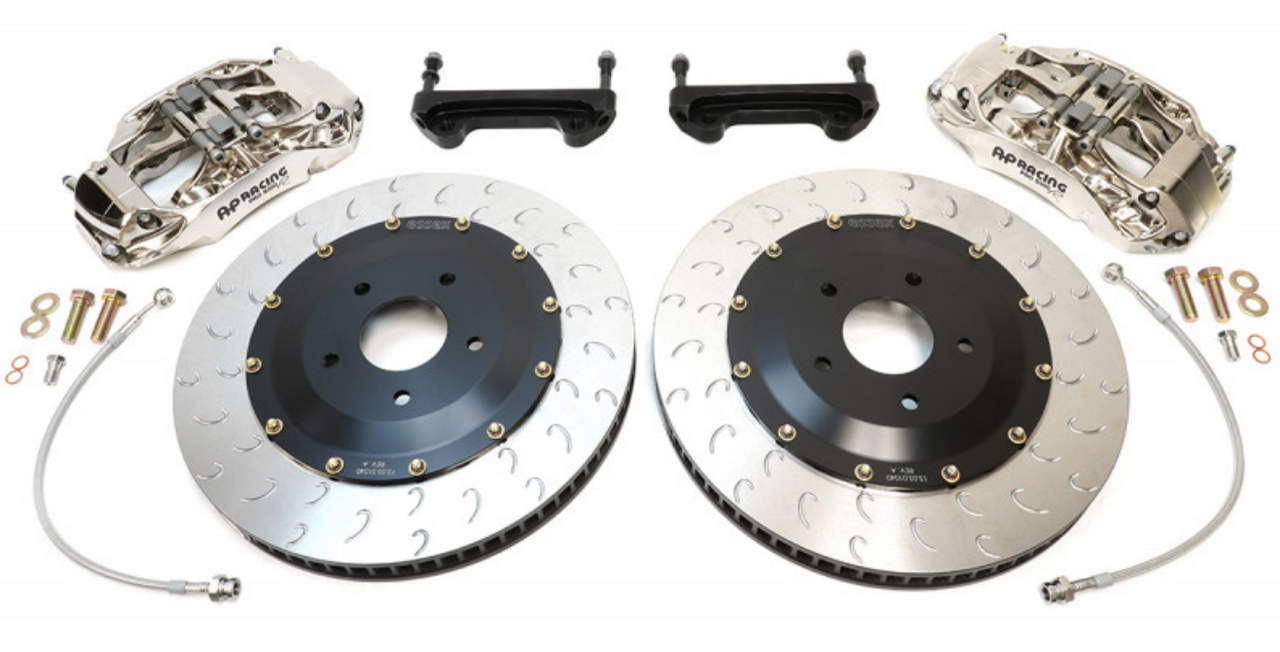
AP Racing Limited
AP Racing Radi-CAL 380mm Competition Brake Kit Porsche 992 GT3/GT3RS (Rear)
from $6,199.00
AP Racing Radi-CAL 380mm Competition Brake Kit Porsche 992 GT3/GT3RS (Rear)
Fit The Following Cars
Porsche 992 GT3
Porsche 992 GT3RS
Complete AP Racing Radi-CAL Competition Brake Kit. Fits all variants of the Porsche 992 GT3/GT3RS:
Eliminates the need to remove the caliper for pad changes
Retains OEM parking brake functionality
Jewel-like ENP Caliper finish is incredibly durable and easy to clean
Saves 18 unsprung lbs. vs. OEM iron brakes and weighs almost the same as the OEM PCCB system
AP Racing Radi-CAL with durable, ventilated stainless steel pistons (no ceramic piston caps to break) with anti-knockback springs
Allows for the preservation of pricey OEM brake components
Huge array of brake pad options from all major pad manufacturers
Fits OEM 20" wheels without spacer
380 x 32mm, 72 vane AP Racing disc fits inside popular 19" wheels
Every component designed to resist the heat of extended track sessions
Pistons sized properly to allow for seamless integration with OEM master cylinder and ABS system
Includes pad tension kit (eliminates noise) and disc burnishing at no additional cost
Designed to work with the front AP Racing Radi-Cal brake kit
AP Racing Limited
AP Racing Radi-CAL 394mm Competition Brake Kit Porsche 992 GT3/GT3RS (Front)
from $7,349.00
AP Racing Radi-CAL 394mm Competition Brake Kit 992 GT3/GT3RS (Front)
Fit The Following Cars
Porsche 992 GT3
Porsche 992 GT3RS
Complete AP Racing Radi-CAL Competition Brake Kit for the Porsche 992 GT3/GT3RS (Front)
May interfere with front anti-roll bar under certain conditions. Please see TSB below.
Jewel-like ENP Caliper finish is incredibly durable and easy to clean
Durable, ventilated stainless steel pistons (no ceramic piston caps to break) with anti-knockback springs
Design eliminates the need to remove caliper for pad changes
Saves 17 unsprung lbs. vs. OEM iron brakes and very close in weight to the OEM PCCB system
Allows for the preservation of pricey OEM brake components
Huge array of brake pad options from all major pad manufacturers
394x34mm, 84 vane AP Racing J Hook Discs
Every component designed to resist the heat of extended track sessions
Pistons sized properly to allow for seamless integration with OEM master cylinder and ABS system
Includes pad tension kit (eliminates noise) and disc burnishing at no additional cost
Designed to work with OEM rear brakes or the Ap Racing rear brake kit
Includes the AP Racing pad tension kit and disc burning at no additional cost
Designed to work with OEM rear brakes or the AP Racing Rear Brake Kit
Porsche 992 Technical Service Bulletin ("TSB")
The Porsche 992 GT3/GT3RS introduced some dramatic suspension changes vs. the 991 chassis, most notably moving from a McPherson Strut configuration to double wishbone at the front of the car. The resulting packaging and geometry changes create some potential brake clearance issues under certain driving conditions. With the brake lines attached to the standard front caliper inlet port contact may occur between the brake line banjo fitting and the front anti-roll bar (ARB) drop links or the ARB itself. The interference issue is more pronounced in our CP9669 Kits due to the extremely wide calipers but can also impact our CP9661 Kits to a lesser extent.
Porsche delivers these cars with the front and rear ARBs set to the middle position. Potential interference between the brake line fitting and drop links becomes more likely to occur as:
The anti-roll bar is adjusted towards the softest setting (the hole closest to the end of the bar)
The steering wheel is turned towards full lock
The suspension is under full droop (extended as far as possible)
To address this clearance issue, AP Racing has developed the following solution:
Relocate the caliper hydraulic connection from its current position to the lower bleed screw. This requires a new Spiegler brake line of a different length with a new banjo bolt design manufactured by Spiegler.
The original inlet port in the center of the AP Racing caliper will be closed off with a plug.
CP9661 Kit, part# 13.01.10141/13.01.10141-ENP
On our CP9661 front caliper kits in the as-delivered configuration (brake line attached to the inlet port in the middle of the caliper), interference between the drop link and the brake line fitting may occur when the ARB is adjusted to the softest setting as you approach full steering lock and full suspension droop.
If you won’t be running the ARB in the softest setting with our CP9661 kit, you should not anticipate any issues, and you should not expect any interference when the ARB is set to the medium or stiff settings. If you do plan to run your front ARB in the softest setting, we suggest implementing our brake line relocation as described above, which will provide adequate clearance in all ARB settings.
CP9669 Kit, part# 13.01.10142-ENP
The wider calipers in our CP9669 kits extend further into the wheel well, which creates more potential clearance issues. With the brake line attached to the center inlet port and the ARB set in the soft or middle settings, there may be interference between the brake line banjo fitting or the caliper body with both the ARB drop links or the ARB itself.
With the brake line relocated to the lower bleed screw port, the CP9669 calipers have adequate clearance with the front anti-roll bar end links when they are set in the middle or stiffest positions. The caliper will not clear the front anti-roll bar adjusted to its softest setting, so the ARB cannot be run in that setting. Under full droop and full lock, the end of the anti-roll bar itself may make minor contact with the inlet port plug, but the likelihood of putting the components in those positions under normal driving conditions is very low.
AP Racing Limited
AP Racing Radi-CAL 380mm Competition Brake Kit (Rear)
from $6,199.00
AP Racing Radi-CAL 380mm Competition Brake Kit (Rear)
Fit The Following Cars
Porsche 991 GT2RS
Porsche 991 GT3
Porsche 991 GT3RS
Complete rear AP Racing Radi-CAL Competition Brake Kit. Fits all variants of the Porsche 991 GT3/3RS/2RS.
Eliminates the need to remove the caliper for pad changes
Retains OEM parking brake functionality
Saves 18 unsprung lbs. vs. OEM iron brakes and weighs almost the same as the OEM PCCB system
Jewel-like ENP caliper finish is incredibly durable and easy to clean
AP Racing Radi-CAL with durable, ventilated stainless steel pistons (no ceramic piston caps to break) with anti-knockback springs
Allows for the preservation of pricey OEM brake components
Huge array of brake pad options from all major pad manufacturers
Fits OEM 20" wheels without spacer
380x32mm, 72 vane AP Racing disc fits inside popular 19" wheels
Every component designed to resist the heat of extended track sessions
Pistons sized properly to allow for seamless integration with OEM master cylinder and ABS system
Includes pad tension kit (eliminates noise) and disc burning at no additional cost
Designed to work with Ap Racing front Brake Kit
AP Racing Limited
AP Racing 408x34mm 2-piece J Hook Front Brake Rotors - Porsche GT4RS (OEM Iron & PCCB)
$2,649.00
AP Racing by Essex 2-piece "S" Vane J Hook Front Brake Rotors (Front 408 x 34mm)- Porsche GT4RS Iron & PCCB
Fit The Following Cars (w/ OEM Iron Rotors or PCCB Rotors)
Porsche GT4RS OEM Iron or PCCB (Front)
Sold/priced per pair.
AP Racing 2-piece S Vane Competition J Hook front disc pair for GT4RS with iron or PCCB discs.
***Note for PCCB cars - must be used with the smaller D62 iron disc pad shape (Ferodo FCP4664 - DS3.12 / DS1.11)
Massive increase in airflow, cooling capacity, and durability vs. OEM discs or even conventional curved vane discs
408mm x 34mm (16.06" x 1.34") , 84 Sinusoidal "wave" vanes, D62 radial depth
Designed for: club racing, time trial, autocross, HPDE
Works with OEM calipers, no modifications required
Ultralight, fully floating, anodized billet aluminum hat with float control/anti-rattle clips
We are introducing a new internal vane technology in our front 2-piece discs for the GT4RS. It is called the Sinusoidal Vane, which AP sometimes refers to internally as the 'Wave' Vane for obvious reasons as you’ll see below. This tech is something that has helped AP Racing brake systems win championships in international GT racing, as well as multiple NASCAR Cup championships here in North America. As one of the most desirable track weapons on the planet, we wanted the GT4RS to be the first production car application for this technology in North America. Just as AP Racing's Radi-CAL calipers set a new benchmark for caliper stability, cooling, and durability, the Sinusoidal Vanes have done the same for iron racing discs.
The concept for this disc design originated in NASCAR Cup. Up until the debut of the Next Gen car (for which AP/Essex are supplying the spec brake package), we were cramming our brake systems inside tiny 15” wheels. Trying to squeeze adequate brake thermal mass into a wheel that small is incredibly challenging, particularly when you have a 1,000 HP and 3,000 pounds mashing on them every few seconds from 200 mph…for hours on end! In a wheel that small, there isn’t anywhere for the heat to go, and the durability of every component is crucial. We were constantly looking for ways to provide the Cup teams with increased durability, stability, and cooling, and that’s what led AP to this technology.
Benefits of the Wave Vane disc technology vs. traditional curved vanes:
Increased thermal stability- Wild temperature swings are what causes discs to crack. When you stand on the brakes for an approaching corner, your disc temperatures skyrocket and the iron expands. As you travel down the subsequent straight, the discs are blasted with cooling air. The longer the straight and the higher the speed, the greater the temperature drop, and the further the iron contracts. This expansion and contraction cycle places a huge amount of stress on the iron and is what causes them to eventually crack. That’s why tracks with relatively slow corners at the end of high-speed straights, followed by another long straight, decimate brake discs (think Watkins Glen or Road America). In an ideal world, once you brought your discs up to race temps, you would keep them at a constant temperature for the entire session. The Sinusoidal Vane brings the discs closer to that goal by decreasing the difference between the maximum and minimum disc temperature by as much as 35%. That means a less dramatic temperature swing and greater crack resistance and durability.
Reduced maximum disc temperatures by 10%+: Not only are temperature swings less intense with the Wave Vane, the maximum temperatures reached are substantially lower. For example, in one NASCAR test the Wave Vane discs showed a peak temp of 1328F and a minimum temp of 1085F (delta of 243F), while the traditional curved vanes maxed out at 1490F and a min of 1121F (delta of 369F). Not only was the difference between min and max more subdued, the max temperature reached by the Wave Vane disc was 162F lower!
Increased cooling surface area- Each of the internal Wave Vanes has a larger cooling surface area vs. a traditional curved vane.
Greater support for the disc face- A disc’s internal vane structure provides the support lattice behind the disc face. Having many internal vanes impacts airspeed and heat transfer through the disc, reduces air recirculation between vanes, and reduces deflection at the disc face. In practical terms, a disc with a high number of vanes is more thermally stable, maintains more even contact with the brake pads (which reduces uneven pad deposits/judder), and is less prone to distortion. In summary, the Wave Vane design provides even greater support for the disc face than AP’s standard curved vane designs.
Reduced weight- The Wave Vane design provides a slight unsprung weight reduction vs. a similar disc with curved internal vanes.
AP Racing J Hook Brake Rotors – The Gold Standard in Track Day & Racing Performance
Engineered for professional motorsport, HPDE, and dedicated track day use, AP Racing’s J Hook Brake Rotors deliver uncompromising performance, thermal stability, and consistent braking power. These two-piece, floating rotors are built to handle the extreme demands of road racing, with design features derived from over 50 years of elite competition—including Formula 1, NASCAR, and IMSA.
Unlike conventional one-piece rotors, AP Racing’s two-piece floating design features a billet aluminum hat mated to a cast iron disc via precision-engineered bobbins. This setup allows for controlled radial expansion under high heat, minimizing distortion and coning. The result? More even pad wear, a firmer pedal feel, and longer component life, even during extended lapping sessions or endurance racing. Floating hardware includes anti-knockback spring clips that reduce piston retraction while eliminating common NVH issues like rattling.
Why Choose AP Racing J Hook Rotors? Advanced Cooling, Superior Bite, Unmatched Durability
At the heart of every rotor is AP Racing’s proprietary high-carbon iron alloy, developed to withstand repeated thermal cycling without cracking or warping. Internally, directional vanes—far superior to OEM pillar or straight vane designs—maximize airflow and cooling. With 60 to 84 vanes per rotor, AP Racing achieves faster heat evacuation, reduced brake fade, and a more consistent friction surface. These rotors are left/right-specific for optimal airflow and balance.
The exclusive J Hook slot pattern offers enhanced initial bite and promotes uniform heat distribution across the rotor face, reducing pad deposits and vibration. Unlike drilled rotors or straight-slot competitors, the J Hook design provides cleaner pad transfer during bed-in and superior modulation under braking—ideal for serious drivers who demand feedback and control. Yes, you might hear a little more whirr, but you’ll gain the stopping power, consistency, and longevity your lap times demand.
Premium Components, Affordable Performance
The rotor hats are CNC-machined from 6061-T6 billet aluminum and hard anodized for strength and heat resistance. Scalloped edges under the hat further assist heat dissipation. All hardware is U.S.-made to AP Racing spec, the same quality found on pro-level racing platforms.
And while these rotors are race-proven, they’re also surprisingly cost-effective to replace. Don’t settle for cheap rotors that crack after a weekend—AP’s J Hook rings offer better durability and real long-term value. Fewer replacements mean more track time, less downtime, and peace of mind knowing you're running the best.
Used by Champions. Trusted by Experts.
From endurance racers to HPDE enthusiasts, AP Racing brake rotors are trusted worldwide for their reliability, longevity, and performance under pressure. Whether you're shaving seconds off your lap time or building a dedicated track car, the J Hook delivers a professional-grade solution that won’t let you down.
AP Racing J Hook Brake Rotors for Auto Racing, Track Days & HPDE
Why Rotor Design Matters: Heat Expansion and Floating Technology
As with most metals, iron brake discs expand significantly under heat. When temperatures rise, the disc grows radially—expanding in both diameter and circumference. Traditional one-piece rotors struggle to accommodate this natural expansion. As the outer edge pulls away from the center under heat stress, it creates a condition called “coning”—a distortion that compromises pad-to-rotor contact. This distortion can lead to uneven pad wear, brake tapering, and an inconsistent, long brake pedal.
AP Racing two-piece floating brake rotors are purpose-built to eliminate these issues. Engineered with “float” built into the disc or hat assembly, these rotors feature oblong-shaped mounting holes that allow the hardware to slide as the disc heats up. This flexibility ensures the disc runs true within the caliper under high-temperature loads, effectively reducing distortion, minimizing pad taper and stress cracks, and promoting longer component life.
Custom Mounting Hardware & Anti-Knockback Spring Clips
AP Racing rotors utilize application-specific, U.S.-made mounting hardware—not generic bolts. These premium components are the exact parts used in AP’s professional motorsport products, engineered to withstand the rigors of competitive racing.
To manage lateral disc motion that can push caliper pistons backward (known as knockback), AP Racing integrates anti-knockback spring clips on alternating bobbins—five on a ten-bolt setup, six on a twelve-bolt disc. These clips keep the aluminum hat and iron disc ring properly aligned while still allowing for radial float. Bonus: they eliminate annoying rattles and vibrations, ensuring a quieter, more refined braking experience.
High-Performance Hat Design for Heat Isolation
The disc hats in AP Racing’s two-piece floating rotors are CNC-machined from 6061-T6 billet aluminum and finished with a hard anodized coating. This high-strength aluminum alloy was selected for its ability to maintain structural integrity even at elevated temperatures. AP adds scalloped channels beneath the hat to further encourage airflow and heat evacuation from the outer disc face, minimizing thermal transfer to hubs and wheel bearings—helping reduce maintenance costs on these expensive components.
J Hook Slot Pattern: Exclusive to AP Racing
Slots and drill holes may improve initial bite, but they also introduce “cool spots” in the rotor face—areas of uneven heating that can lead to stress risers, cracks, and pad vibration. OEM rotors often avoid this by leaving the disc face blank, but that compromises bite and brake feel.
AP Racing’s patented J Hook design, developed through rigorous R&D, solves this problem. The hooks are meticulously spaced around the disc’s circumference and from hat to edge, forming a continuous distortion path that ensures even heat distribution. This encourages uniform pad deposits during bed-in, helps reduce judder and cracking, and improves consistency under repeated high-load braking.
In addition, the J Hook slots provide more leading edges for pads to grip than traditional curved slots or blank rotors. While this might generate a mild whirring sound during braking, the benefits—more bite, cleaner bedding, better pedal feel—make it the top choice for committed racers and serious track day drivers.
Metallurgy Backed by 50+ Years of Motorsport Leadership
AP Racing's reputation is built on performance, and their proprietary iron alloy used in J Hook rotors is no exception. Drawing from over five decades of elite motorsport experience, including 750+ Formula 1 wins and widespread use across NASCAR, AP’s engineers have developed a disc alloy that excels under sustained racing temperatures and stress. Where OEM discs focus on affordability and mass production, AP Racing’s J Hook rotors are purpose-built for motorsport durability and heat resistance.
Affordable Replacement Cost: Serious Value for Serious Drivers
Even the best brake rotors are consumables. When you drive hard—especially at the track—your discs will eventually wear out. That’s why AP Racing designed their replacement iron rings to be cost-effective, allowing you to replace worn parts without breaking the bank.
Compare that to constantly buying cheap $150 rotors every weekend—rotors that can't handle the heat and need to be swapped frequently. With AP Racing’s J Hook rotors, you get longer service intervals, less downtime, and better performance over time, making them an incredibly smart long-term investment.
Proven on Track. Trusted by Champions.
Top-tier racing teams rely on AP Racing J Hook rotors for one reason: they perform under pressure. Whether you're running time trials, attending HPDE events, or competing in wheel-to-wheel racing, these rotors offer professional-grade reliability, safety, and performance.
Bedding and preparation of AP Racing J Hook Disc
Properly preparing your new brake discs before heavy use is extremely important. The goal of bedding-in your brake pads and discs is to mate them together properly and prepare them for heavy use. When prepared properly, or bed-in, your pads will transfer a thin layer of material to the disc face (transfer layer). The pads in your caliper will then actually ride on that thin layer of pad material you’ve put down on the rotor, rather than rubbing directly on the iron rotor face. A good transfer layer is going to give you superior brake pedal feel, less noise, superior pad wear, and lower the chances of cracking your discs.
Important Notes- PLEASE READ! First, make sure you are on a closed course to perform a proper bed-in. Do NOT perform the procedure on public roads. You need a stretch of asphalt with long straights, good visibility, and no potential obstructions. Make sure you are in a position to safely and repeatedly attain the necessary speeds to perform the bed-in procedure. A controlled racetrack is the best place to perform this procedure. AP Racing and Competition Motorsport in no way suggest or condone speeding on public roads or breaking the law in your car, nor do we take responsibility for any damage or injury that occurs as a result of using our product or these procedures. You are performing the bed-in procedure at your own risk.
During these procedures, it’s critical that you never come to a complete stop with your foot on the brake pedal. If you have brake ducts on your car, you may want to block them off to allow your brake system to heat up easily. The procedure outlined below is a generic procedure for most types of mild race pad. Please check your pad manufacturer’s recommended bed-in procedure.
Accelerate to approximately 60mph and then decelerate down to 5 mph. If your car has ABS, you should try to hold the brakes at a point just before ABS intervention.
Once the car slows to 5mph, immediately accelerate back up to about 60mph, and brake again to roughly 5mph.
Repeat this series of stopping and accelerating 8 to 10 times. Again, do not come to a complete stop with your foot on the brake pedal.
Cool the brake system down by cruising at 45mph+ for 5 to 10 minutes.
Visually inspect your discs. They should be a blue/grey color (instead of shiny silver), and have an even layer of pad material across and around the entire rotor face.
If the AP Racing rotors don’t have a layer of pad material on them, perform another series of stops in the manner outlined above.
AP Racing Limited
AP Racing 380mmx34mm 2-piece J Hook Front Brake Rotors for Porsche (OEM Iron)
$2,199.00
AP Racing 380x34mm 2-piece J Hook Front Floating Racing Brake Rotors
Fit The Following Cars (w/ OEM Iron Rotors)
Porsche 991 GT3 (Front)
Porsche 991 GT3RS (Front)
Porsche 981 GT4 (Front)
AP Racing 2-piece Competition J Hook front disc pair for 981 GT4, 991.1 & 991.2 GT3 & GT3 RS with iron discs
380mm x 34mm (14.96" x 1.34") 72 Vane, D66
Huge increase in airflow, cooling capacity, and durability vs. OEM discs
Saves 2 lbs. unsprung weight per side vs. OEM iron discs
Designed for: club racing, time trial, auto-x, HPDE
Works with OEM calipers, no modifications required
Ultralight, fully floating, anodized billet aluminum hat with float control/anti-rattle clips
Sold/priced per pair.
AP Racing J Hook Brake Rotors – The Gold Standard in Track Day & Racing Performance
Engineered for professional motorsport, HPDE, and dedicated track day use, AP Racing’s J Hook Brake Rotors deliver uncompromising performance, thermal stability, and consistent braking power. These two-piece, floating rotors are built to handle the extreme demands of road racing, with design features derived from over 50 years of elite competition—including Formula 1, NASCAR, and IMSA.
Unlike conventional one-piece rotors, AP Racing’s two-piece floating design features a billet aluminum hat mated to a cast iron disc via precision-engineered bobbins. This setup allows for controlled radial expansion under high heat, minimizing distortion and coning. The result? More even pad wear, a firmer pedal feel, and longer component life, even during extended lapping sessions or endurance racing. Floating hardware includes anti-knockback spring clips that reduce piston retraction while eliminating common NVH issues like rattling.
Why Choose AP Racing J Hook Rotors? Advanced Cooling, Superior Bite, Unmatched Durability
At the heart of every rotor is AP Racing’s proprietary high-carbon iron alloy, developed to withstand repeated thermal cycling without cracking or warping. Internally, directional vanes—far superior to OEM pillar or straight vane designs—maximize airflow and cooling. With 60 to 84 vanes per rotor, AP Racing achieves faster heat evacuation, reduced brake fade, and a more consistent friction surface. These rotors are left/right-specific for optimal airflow and balance.
The exclusive J Hook slot pattern offers enhanced initial bite and promotes uniform heat distribution across the rotor face, reducing pad deposits and vibration. Unlike drilled rotors or straight-slot competitors, the J Hook design provides cleaner pad transfer during bed-in and superior modulation under braking—ideal for serious drivers who demand feedback and control. Yes, you might hear a little more whirr, but you’ll gain the stopping power, consistency, and longevity your lap times demand.
Premium Components, Affordable Performance
The rotor hats are CNC-machined from 6061-T6 billet aluminum and hard anodized for strength and heat resistance. Scalloped edges under the hat further assist heat dissipation. All hardware is U.S.-made to AP Racing spec, the same quality found on pro-level racing platforms.
And while these rotors are race-proven, they’re also surprisingly cost-effective to replace. Don’t settle for cheap rotors that crack after a weekend—AP’s J Hook rings offer better durability and real long-term value. Fewer replacements mean more track time, less downtime, and peace of mind knowing you're running the best.
Used by Champions. Trusted by Experts.
From endurance racers to HPDE enthusiasts, AP Racing brake rotors are trusted worldwide for their reliability, longevity, and performance under pressure. Whether you're shaving seconds off your lap time or building a dedicated track car, the J Hook delivers a professional-grade solution that won’t let you down.
AP Racing J Hook Brake Rotors for Auto Racing, Track Days & HPDE
Why Rotor Design Matters: Heat Expansion and Floating Technology
As with most metals, iron brake discs expand significantly under heat. When temperatures rise, the disc grows radially—expanding in both diameter and circumference. Traditional one-piece rotors struggle to accommodate this natural expansion. As the outer edge pulls away from the center under heat stress, it creates a condition called “coning”—a distortion that compromises pad-to-rotor contact. This distortion can lead to uneven pad wear, brake tapering, and an inconsistent, long brake pedal.
AP Racing two-piece floating brake rotors are purpose-built to eliminate these issues. Engineered with “float” built into the disc or hat assembly, these rotors feature oblong-shaped mounting holes that allow the hardware to slide as the disc heats up. This flexibility ensures the disc runs true within the caliper under high-temperature loads, effectively reducing distortion, minimizing pad taper and stress cracks, and promoting longer component life.
Custom Mounting Hardware & Anti-Knockback Spring Clips
AP Racing rotors utilize application-specific, U.S.-made mounting hardware—not generic bolts. These premium components are the exact parts used in AP’s professional motorsport products, engineered to withstand the rigors of competitive racing.
To manage lateral disc motion that can push caliper pistons backward (known as knockback), AP Racing integrates anti-knockback spring clips on alternating bobbins—five on a ten-bolt setup, six on a twelve-bolt disc. These clips keep the aluminum hat and iron disc ring properly aligned while still allowing for radial float. Bonus: they eliminate annoying rattles and vibrations, ensuring a quieter, more refined braking experience.
High-Performance Hat Design for Heat Isolation
The disc hats in AP Racing’s two-piece floating rotors are CNC-machined from 6061-T6 billet aluminum and finished with a hard anodized coating. This high-strength aluminum alloy was selected for its ability to maintain structural integrity even at elevated temperatures. AP adds scalloped channels beneath the hat to further encourage airflow and heat evacuation from the outer disc face, minimizing thermal transfer to hubs and wheel bearings—helping reduce maintenance costs on these expensive components.
Internal Vane Engineering: Airflow Optimization & Thermal Stability
AP Racing’s internal vane design sets them apart from OEM and most aftermarket competitors. While many factory brake discs use non-directional pillar vanes (low-cost and NVH-focused), AP Racing rotors use directional vanes engineered for maximum airflow. These rotors are side-specific—meaning you’ll receive a unique left and right disc in each set—ensuring optimized cooling through strategic vane orientation and shape.
Beyond that, AP Racing rotors feature a superior vane count, typically ranging from 60 to 84 vanes, compared to 30–48 in most aftermarket rotors. After extensive CFD and thermal analysis, this high vane count was proven to:
Increase airspeed and thermal transfer
Reduce recirculation and deflection at the disc face
Minimize coning, cracking, and brake fade
Deliver more even pad contact and extended rotor life
J Hook Slot Pattern: Exclusive to AP Racing
Slots and drill holes may improve initial bite, but they also introduce “cool spots” in the rotor face—areas of uneven heating that can lead to stress risers, cracks, and pad vibration. OEM rotors often avoid this by leaving the disc face blank, but that compromises bite and brake feel.
AP Racing’s patented J Hook design, developed through rigorous R&D, solves this problem. The hooks are meticulously spaced around the disc’s circumference and from hat to edge, forming a continuous distortion path that ensures even heat distribution. This encourages uniform pad deposits during bed-in, helps reduce judder and cracking, and improves consistency under repeated high-load braking.
In addition, the J Hook slots provide more leading edges for pads to grip than traditional curved slots or blank rotors. While this might generate a mild whirring sound during braking, the benefits—more bite, cleaner bedding, better pedal feel—make it the top choice for committed racers and serious track day drivers.
Metallurgy Backed by 50+ Years of Motorsport Leadership
AP Racing's reputation is built on performance, and their proprietary iron alloy used in J Hook rotors is no exception. Drawing from over five decades of elite motorsport experience, including 750+ Formula 1 wins and widespread use across NASCAR, AP’s engineers have developed a disc alloy that excels under sustained racing temperatures and stress. Where OEM discs focus on affordability and mass production, AP Racing’s J Hook rotors are purpose-built for motorsport durability and heat resistance.
Affordable Replacement Cost: Serious Value for Serious Drivers
Even the best brake rotors are consumables. When you drive hard—especially at the track—your discs will eventually wear out. That’s why AP Racing designed their replacement iron rings to be cost-effective, allowing you to replace worn parts without breaking the bank.
Compare that to constantly buying cheap $150 rotors every weekend—rotors that can't handle the heat and need to be swapped frequently. With AP Racing’s J Hook rotors, you get longer service intervals, less downtime, and better performance over time, making them an incredibly smart long-term investment.
Proven on Track. Trusted by Champions.
Top-tier racing teams rely on AP Racing J Hook rotors for one reason: they perform under pressure. Whether you're running time trials, attending HPDE events, or competing in wheel-to-wheel racing, these rotors offer professional-grade reliability, safety, and performance.
Bedding and preparation of AP Racing J Hook Disc
Properly preparing your new brake discs before heavy use is extremely important. The goal of bedding-in your brake pads and discs is to mate them together properly and prepare them for heavy use. When prepared properly, or bed-in, your pads will transfer a thin layer of material to the disc face (transfer layer). The pads in your caliper will then actually ride on that thin layer of pad material you’ve put down on the rotor, rather than rubbing directly on the iron rotor face. A good transfer layer is going to give you superior brake pedal feel, less noise, superior pad wear, and lower the chances of cracking your discs.
Important Notes- PLEASE READ! First, make sure you are on a closed course to perform a proper bed-in. Do NOT perform the procedure on public roads. You need a stretch of asphalt with long straights, good visibility, and no potential obstructions. Make sure you are in a position to safely and repeatedly attain the necessary speeds to perform the bed-in procedure. A controlled racetrack is the best place to perform this procedure. AP Racing and Competition Motorsport in no way suggest or condone speeding on public roads or breaking the law in your car, nor do we take responsibility for any damage or injury that occurs as a result of using our product or these procedures. You are performing the bed-in procedure at your own risk.
During these procedures, it’s critical that you never come to a complete stop with your foot on the brake pedal. If you have brake ducts on your car, you may want to block them off to allow your brake system to heat up easily. The procedure outlined below is a generic procedure for most types of mild race pad. Please check your pad manufacturer’s recommended bed-in procedure.
Accelerate to approximately 60mph and then decelerate down to 5 mph. If your car has ABS, you should try to hold the brakes at a point just before ABS intervention.
Once the car slows to 5mph, immediately accelerate back up to about 60mph, and brake again to roughly 5mph.
Repeat this series of stopping and accelerating 8 to 10 times. Again, do not come to a complete stop with your foot on the brake pedal.
Cool the brake system down by cruising at 45mph+ for 5 to 10 minutes.
Visually inspect your discs. They should be a blue/grey color (instead of shiny silver), and have an even layer of pad material across and around the entire rotor face.
If the AP Racing rotors don’t have a layer of pad material on them, perform another series of stops in the manner outlined above.
GiroDisc Racing Brakes & Technologies
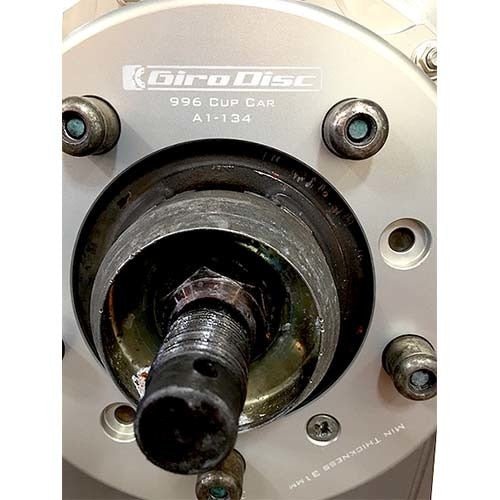
A1-134 Girodisc Non-Floating 2pc Front Brake Rotors (350mm) (Garage Sale)
$780.66
$1,200.00
A1-134 Girodisc Non-Floating 2pc Front Brake Rotors (350mm)
Competition Motorsport is an Authorized dealer for GiroDisc products and the exclusive distributor for the non-floating 2-piece rotors for the 996 GT3 Cup car. We are one of the largest stocking dealers in the country. We ship most products same or next business day to ensure we meet your delivery deadline.
Fits Porsche 911 GT3 Cup Car (2000-05)
Discontinued New old stock rotor. These have the straight grooves as images show, not the new curved grooves. Final Sale, no returns or exchanges.
The GiroDisc system is an upgrade to the 2000-2001 GT3 Cup cars and a direct replacement for the 2002-2005 GT3 Cup cars that came with the OEM 6-piston 350mm setup. These are 2-piece non-floating steel rotor and aluminum hat combination and is a direct replacement for the OEM brake disc. The 2-piece floating disc will bolt directly to the car and work with OEM calipers perfectly. By upgrading your brakes with these lightweight high-performance replacements as opposed to a big brake kit, your factory bias is maintained as well as your ABS efficiency. The Giro Disc rotors are lighter than OEM pieces. The reduction in rotational and unsprung weight allows for quicker acceleration and suspension response.
When used with Pagid or PFC performance brake pads, and Competition Motorsport RF-1 brake fluid (also available from CompetitionMotorsport.com), you have an amazing solution to overheating, cracking and warping rotors.
The central hat section of the disc is made from 6061-T6 aircraft specification aluminum. The disc is manufactured from cast iron which is constructed in the USA and is made to the same specification with the same material used by professional racing organizations. The rotors curved vane design was developed in racing and acts as a centrifugal pump to force cooling air through the disc.
The rotor and hat mount together through a non-floating mount system which utilizes 8-10 high strength alloy steel drive pins manufactured by GiroDisc in the USA to our own specifications and are cadmium plated for corrosion resistance. The alloy drive pins transfer the load from the brake action while maintaining the axial and radial float between the disc rotor and hat.
The 2-piece GiroDisc design allows for rotor only replacement as well to minimize future replacement costs and deliver outstanding performance and cooling.
Sold/Priced per pair.
GiroDisc Racing Brakes & Technologies
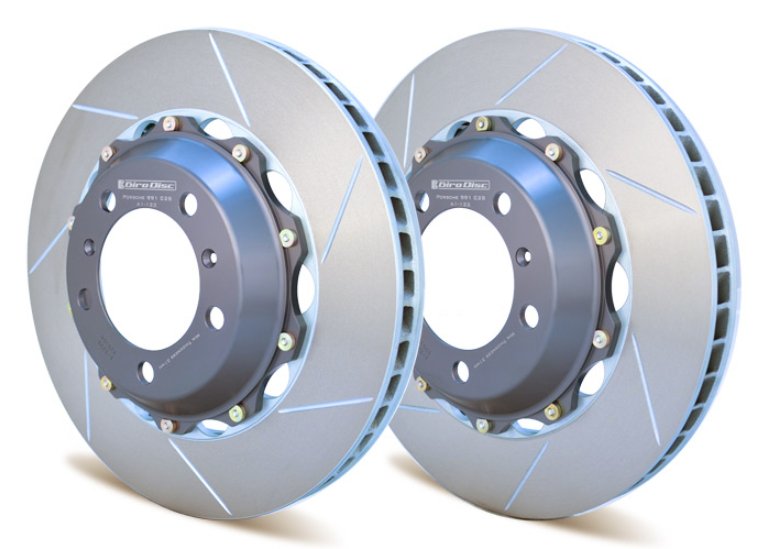
A1-122 Girodisc 2pc Front Brake Rotors (350mm) (Garage Sale)
$877.66
$1,350.00
A1-122 Girodisc Two-Piece 350mm Front Brake Rotors (Discontinued Design)
FITMENT:
Porsche Carrera S 991.2
Porsche Carrera 4S 991.2
Porsche Carrera GTS 991.2
Discontinued New old stock rotor. These have the straight grooves as images show, not the new curved grooves. Final Sale, no returns or exchanges.
This Girodisc system is a direct replacement for OEM Porsche steel (cast iron) rotors1 with the use of the provided caliper spacers. The Girodisc rotors are slightly larger than the stock Porsche rotors at 350mm vs. 340mm, providing greater braking force and cooling capacity. The Girodisc front rotors are approximately 21.0 lbs. vs. 24.4 lbs. for the stock units. This reduction in rotational and unsprung weight allows for quicker acceleration and suspension response.
The central hat section of the disc is made from 6061-T6 aircraft specification aluminum. The disc is manufactured from cast iron constructed in the USA, made to the same specification with the same material used by professional racing organizations. The rotors' curved vane design was developed in racing and acts as a centrifugal pump to force cooling air through the disc.
The rotor and hat mount together through a floating mount system which utilizes ten high strength alloy steel drive pins manufactured by Girodisc in the USA to their own specifications and are cadmium plated for corrosion resistance. The alloy drive pins transfer the load from the brake action while maintaining the axial and radial float between the disc rotor and hat. The pins are secured by Grade-12 cap screws with hardened washers and mounted with anti-noise spring washers to allow for heat expansion while eliminating the rattle and noise associated with floating rotors.
The two-piece Girodisc design allows for disc-only replacement as well, minimizing future replacement costs and delivering outstanding performance.
Sold/priced per pair.
1 Note: this Girodisc kit does not fit Porsche models with factory PCCB brakes.

AP Racing Limited
AP Racing 408x34mm Replacement Front Brake Rotor Rings for Porsche (OEM PCCB or Iron)
$1,627.90
AP Racing 408x34mm J Hook Disc Replacement Front Floating Racing Brake Rotor Rings
Fits the following cars which use AP Racing 13.01.20038 or 13.01.20050 (w/ OEM Iron Rotors or PCCB Rotors) - Center hat Excluded, rotor discs and hardware only. Replacement Disc Only For AP Racing 13.01.20038 or 13.01.20050
Porsche 992 GT3 PCCB/Iron (Front)
Porsche 992 GT3RS PCCB/Iron (Front)
Porsche GT4RS PCCB/Iron (Front)
Sold/priced per pair of replacement rotor rings with hardware.
408mm x 34mm (16.06" x 1.34") 84 Wave Vane, D62, J Hook Iron Racing Brake Disc
We are introducing a new internal vane technology in our front 2-piece discs for the 992 GT3. It is called the Sinusoidal Vane, which AP sometimes refers to internally as the 'Wave' Vane for obvious reasons as you’ll see below. This tech is something that has helped AP Racing brake systems win championships in international GT racing, as well as multiple NASCAR Cup championships here in North America. As one of the most desirable track weapons on the planet, we wanted the 992 GT3 to be the first production car application for this technology in North America. Just as AP Racing's Radi-CAL calipers set a new benchmark for caliper stability, cooling, and durability, the Sinusoidal Vanes have done the same for iron racing discs.
The concept for this disc design originated in NASCAR Cup. Up until the debut of the Next Gen car (for which AP/Essex are supplying the spec brake package), we were cramming our brake systems inside tiny 15” wheels. Trying to squeeze adequate brake thermal mass into a wheel that small is incredibly challenging, particularly when you have a 1,000 HP and 3,000 pounds mashing on them every few seconds from 200 mph…for hours on end! In a wheel that small, there isn’t anywhere for the heat to go, and the durability of every component is crucial. We were constantly looking for ways to provide the Cup teams with increased durability, stability, and cooling, and that’s what led AP to this technology.
Benefits of the Wave Vane disc technology vs. traditional curved vanes:
Increased thermal stability- Wild temperature swings are what causes discs to crack. When you stand on the brakes for an approaching corner, your disc temperatures skyrocket and the iron expands. As you travel down the subsequent straight, the discs are blasted with cooling air. The longer the straight and the higher the speed, the greater the temperature drop, and the further the iron contracts. This expansion and contraction cycle places a huge amount of stress on the iron and is what causes them to eventually crack. That’s why tracks with relatively slow corners at the end of high-speed straights, followed by another long straight, decimate brake discs (think Watkins Glen or Road America). In an ideal world, once you brought your discs up to race temps, you would keep them at a constant temperature for the entire session. The Sinusoidal Vane brings the discs closer to that goal by decreasing the difference between the maximum and minimum disc temperature by as much as 35%. That means a less dramatic temperature swing and greater crack resistance and durability.
Reduced maximum disc temperatures by 10%+: Not only are temperature swings less intense with the Wave Vane, the maximum temperatures reached are substantially lower. For example, in one NASCAR test the Wave Vane discs showed a peak temp of 1328F and a minimum temp of 1085F (delta of 243F), while the traditional curved vanes maxed out at 1490F and a min of 1121F (delta of 369F). Not only was the difference between min and max more subdued, the max temperature reached by the Wave Vane disc was 162F lower!
Increased cooling surface area- Each of the internal Wave Vanes has a larger cooling surface area vs. a traditional curved vane.
Greater support for the disc face- A disc’s internal vane structure provides the support lattice behind the disc face. Having many internal vanes impacts airspeed and heat transfer through the disc, reduces air recirculation between vanes, and reduces deflection at the disc face. In practical terms, a disc with a high number of vanes is more thermally stable, maintains more even contact with the brake pads (which reduces uneven pad deposits/judder), and is less prone to distortion. In summary, the Wave Vane design provides even greater support for the disc face than AP’s standard curved vane designs.
Reduced weight- The Wave Vane design provides a slight unsprung weight reduction vs. a similar disc with curved internal vanes.
AP Racing J Hook Brake Rotors – The Gold Standard in Track Day & Racing Performance
Engineered for professional motorsport, HPDE, and dedicated track day use, AP Racing’s J Hook Brake Rotors deliver uncompromising performance, thermal stability, and consistent braking power. These two-piece, floating rotors are built to handle the extreme demands of road racing, with design features derived from over 50 years of elite competition—including Formula 1, NASCAR, and IMSA.
Unlike conventional one-piece rotors, AP Racing’s two-piece floating design features a billet aluminum hat mated to a cast iron disc via precision-engineered bobbins. This setup allows for controlled radial expansion under high heat, minimizing distortion and coning. The result? More even pad wear, a firmer pedal feel, and longer component life, even during extended lapping sessions or endurance racing. Floating hardware includes anti-knockback spring clips that reduce piston retraction while eliminating common NVH issues like rattling.
Why Choose AP Racing J Hook Rotors? Advanced Cooling, Superior Bite, Unmatched Durability
At the heart of every rotor is AP Racing’s proprietary high-carbon iron alloy, developed to withstand repeated thermal cycling without cracking or warping. Internally, directional vanes—far superior to OEM pillar or straight vane designs—maximize airflow and cooling. With 60 to 84 vanes per rotor, AP Racing achieves faster heat evacuation, reduced brake fade, and a more consistent friction surface. These rotors are left/right-specific for optimal airflow and balance.
The exclusive J Hook slot pattern offers enhanced initial bite and promotes uniform heat distribution across the rotor face, reducing pad deposits and vibration. Unlike drilled rotors or straight-slot competitors, the J Hook design provides cleaner pad transfer during bed-in and superior modulation under braking—ideal for serious drivers who demand feedback and control. Yes, you might hear a little more whirr, but you’ll gain the stopping power, consistency, and longevity your lap times demand.
Premium Components, Affordable Performance
The rotor hats are CNC-machined from 6061-T6 billet aluminum and hard anodized for strength and heat resistance. Scalloped edges under the hat further assist heat dissipation. All hardware is U.S.-made to AP Racing spec, the same quality found on pro-level racing platforms.
And while these rotors are race-proven, they’re also surprisingly cost-effective to replace. Don’t settle for cheap rotors that crack after a weekend—AP’s J Hook rings offer better durability and real long-term value. Fewer replacements mean more track time, less downtime, and peace of mind knowing you're running the best.
Used by Champions. Trusted by Experts.
From endurance racers to HPDE enthusiasts, AP Racing brake rotors are trusted worldwide for their reliability, longevity, and performance under pressure. Whether you're shaving seconds off your lap time or building a dedicated track car, the J Hook delivers a professional-grade solution that won’t let you down.
AP Racing J Hook Brake Rotors for Auto Racing, Track Days & HPDE
Why Rotor Design Matters: Heat Expansion and Floating Technology
As with most metals, iron brake discs expand significantly under heat. When temperatures rise, the disc grows radially—expanding in both diameter and circumference. Traditional one-piece rotors struggle to accommodate this natural expansion. As the outer edge pulls away from the center under heat stress, it creates a condition called “coning”—a distortion that compromises pad-to-rotor contact. This distortion can lead to uneven pad wear, brake tapering, and an inconsistent, long brake pedal.
AP Racing two-piece floating brake rotors are purpose-built to eliminate these issues. Engineered with “float” built into the disc or hat assembly, these rotors feature oblong-shaped mounting holes that allow the hardware to slide as the disc heats up. This flexibility ensures the disc runs true within the caliper under high-temperature loads, effectively reducing distortion, minimizing pad taper and stress cracks, and promoting longer component life.
Custom Mounting Hardware & Anti-Knockback Spring Clips
AP Racing rotors utilize application-specific, U.S.-made mounting hardware—not generic bolts. These premium components are the exact parts used in AP’s professional motorsport products, engineered to withstand the rigors of competitive racing.
To manage lateral disc motion that can push caliper pistons backward (known as knockback), AP Racing integrates anti-knockback spring clips on alternating bobbins—five on a ten-bolt setup, six on a twelve-bolt disc. These clips keep the aluminum hat and iron disc ring properly aligned while still allowing for radial float. Bonus: they eliminate annoying rattles and vibrations, ensuring a quieter, more refined braking experience.
High-Performance Hat Design for Heat Isolation
The disc hats in AP Racing’s two-piece floating rotors are CNC-machined from 6061-T6 billet aluminum and finished with a hard anodized coating. This high-strength aluminum alloy was selected for its ability to maintain structural integrity even at elevated temperatures. AP adds scalloped channels beneath the hat to further encourage airflow and heat evacuation from the outer disc face, minimizing thermal transfer to hubs and wheel bearings—helping reduce maintenance costs on these expensive components.
Internal Vane Engineering: Airflow Optimization & Thermal Stability
AP Racing’s internal vane design sets them apart from OEM and most aftermarket competitors. While many factory brake discs use non-directional pillar vanes (low-cost and NVH-focused), AP Racing rotors use directional vanes engineered for maximum airflow. These rotors are side-specific—meaning you’ll receive a unique left and right disc in each set—ensuring optimized cooling through strategic vane orientation and shape.
Beyond that, AP Racing rotors feature a superior vane count, typically ranging from 60 to 84 vanes, compared to 30–48 in most aftermarket rotors. After extensive CFD and thermal analysis, this high vane count was proven to:
Increase airspeed and thermal transfer
Reduce recirculation and deflection at the disc face
Minimize coning, cracking, and brake fade
Deliver more even pad contact and extended rotor life
J Hook Slot Pattern: Exclusive to AP Racing
Slots and drill holes may improve initial bite, but they also introduce “cool spots” in the rotor face—areas of uneven heating that can lead to stress risers, cracks, and pad vibration. OEM rotors often avoid this by leaving the disc face blank, but that compromises bite and brake feel.
AP Racing’s patented J Hook design, developed through rigorous R&D, solves this problem. The hooks are meticulously spaced around the disc’s circumference and from hat to edge, forming a continuous distortion path that ensures even heat distribution. This encourages uniform pad deposits during bed-in, helps reduce judder and cracking, and improves consistency under repeated high-load braking.
In addition, the J Hook slots provide more leading edges for pads to grip than traditional curved slots or blank rotors. While this might generate a mild whirring sound during braking, the benefits—more bite, cleaner bedding, better pedal feel—make it the top choice for committed racers and serious track day drivers.
Metallurgy Backed by 50+ Years of Motorsport Leadership
AP Racing's reputation is built on performance, and their proprietary iron alloy used in J Hook rotors is no exception. Drawing from over five decades of elite motorsport experience, including 750+ Formula 1 wins and widespread use across NASCAR, AP’s engineers have developed a disc alloy that excels under sustained racing temperatures and stress. Where OEM discs focus on affordability and mass production, AP Racing’s J Hook rotors are purpose-built for motorsport durability and heat resistance.
Affordable Replacement Cost: Serious Value for Serious Drivers
Even the best brake rotors are consumables. When you drive hard—especially at the track—your discs will eventually wear out. That’s why AP Racing designed their replacement iron rings to be cost-effective, allowing you to replace worn parts without breaking the bank.
Compare that to constantly buying cheap $150 rotors every weekend—rotors that can't handle the heat and need to be swapped frequently. With AP Racing’s J Hook rotors, you get longer service intervals, less downtime, and better performance over time, making them an incredibly smart long-term investment.
Proven on Track. Trusted by Champions.
Top-tier racing teams rely on AP Racing J Hook rotors for one reason: they perform under pressure. Whether you're running time trials, attending HPDE events, or competing in wheel-to-wheel racing, these rotors offer professional-grade reliability, safety, and performance.
Bedding and preparation of AP Racing J Hook Disc
Properly preparing your new brake discs before heavy use is extremely important. The goal of bedding-in your brake pads and discs is to mate them together properly and prepare them for heavy use. When prepared properly, or bed-in, your pads will transfer a thin layer of material to the disc face (transfer layer). The pads in your caliper will then actually ride on that thin layer of pad material you’ve put down on the rotor, rather than rubbing directly on the iron rotor face. A good transfer layer is going to give you superior brake pedal feel, less noise, superior pad wear, and lower the chances of cracking your discs.
Important Notes- PLEASE READ! First, make sure you are on a closed course to perform a proper bed-in. Do NOT perform the procedure on public roads. You need a stretch of asphalt with long straights, good visibility, and no potential obstructions. Make sure you are in a position to safely and repeatedly attain the necessary speeds to perform the bed-in procedure. A controlled racetrack is the best place to perform this procedure. AP Racing and Competition Motorsport in no way suggest or condone speeding on public roads or breaking the law in your car, nor do we take responsibility for any damage or injury that occurs as a result of using our product or these procedures. You are performing the bed-in procedure at your own risk.
During these procedures, it’s critical that you never come to a complete stop with your foot on the brake pedal. If you have brake ducts on your car, you may want to block them off to allow your brake system to heat up easily. The procedure outlined below is a generic procedure for most types of mild race pad. Please check your pad manufacturer’s recommended bed-in procedure.
Accelerate to approximately 60mph and then decelerate down to 5 mph. If your car has ABS, you should try to hold the brakes at a point just before ABS intervention.
Once the car slows to 5mph, immediately accelerate back up to about 60mph, and brake again to roughly 5mph.
Repeat this series of stopping and accelerating 8 to 10 times. Again, do not come to a complete stop with your foot on the brake pedal.
Cool the brake system down by cruising at 45mph+ for 5 to 10 minutes.
Visually inspect your discs. They should be a blue/grey color (instead of shiny silver), and have an even layer of pad material across and around the entire rotor face.
If the AP Racing rotors don’t have a layer of pad material on them, perform another series of stops in the manner outlined above.
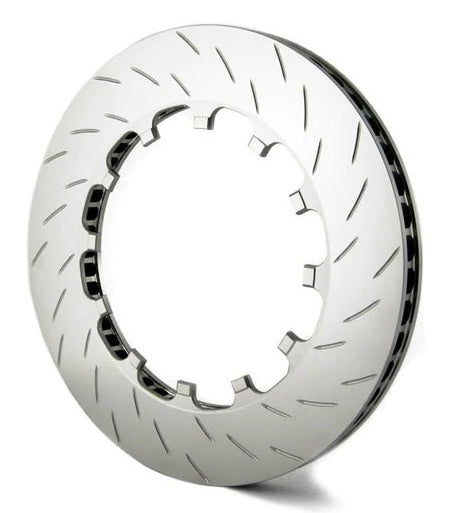
Performance Friction Corporation
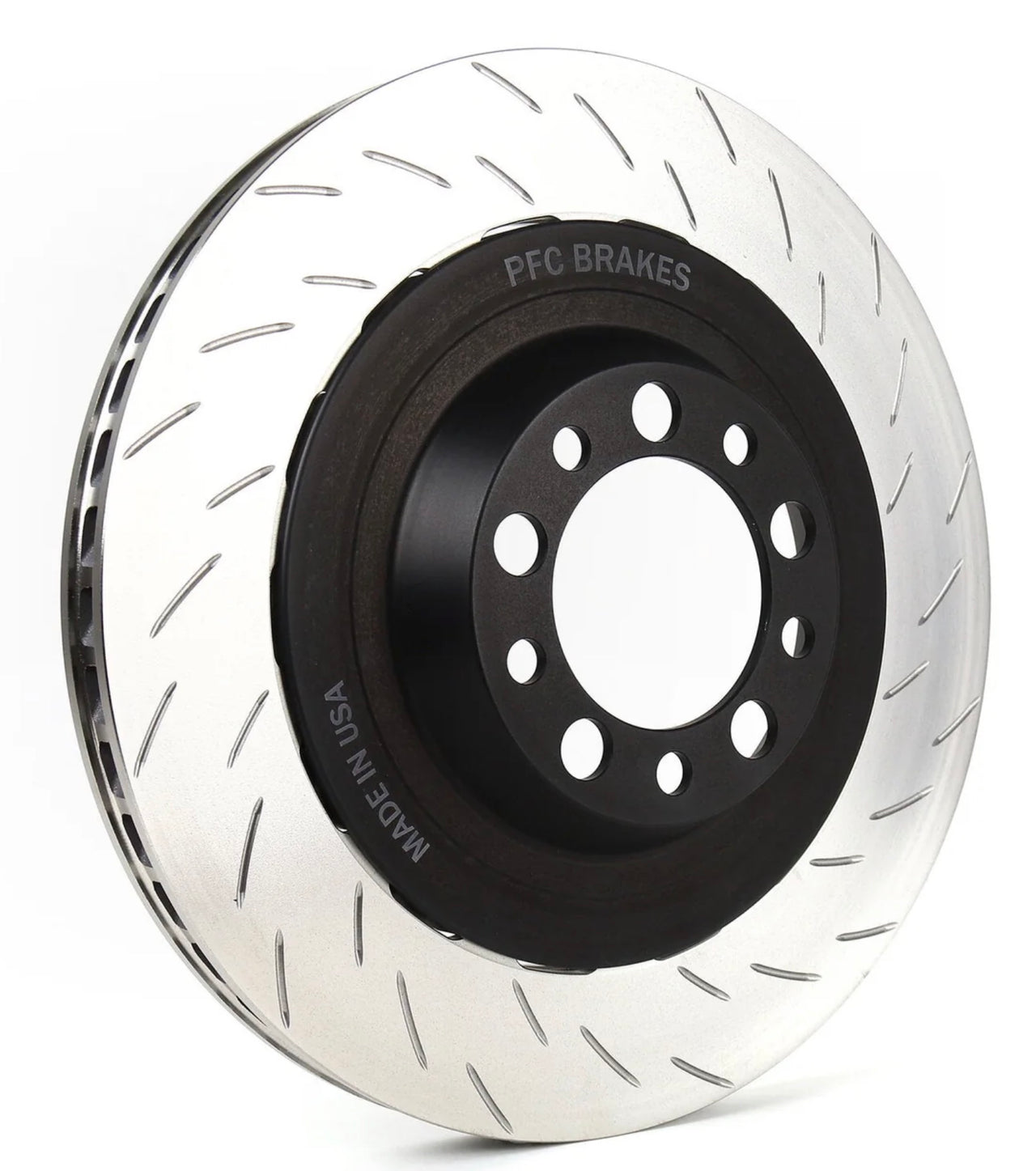
PFC Performance Friction 390mm Replacement Rear Brake Rotors for Porsche (OEM PCCB)
$1,654.90
Performance Friction PFC 390.32.0066.451/461 390mm Replacement Rear Floating Racing Brake Rotors
Fit The Following Cars (w/ OEM PCCB Rotors)- Center hat Excluded, rotor disc only. Replacement Disc Only For PFC 390.075.63/64
Porsche 992 GT3 (Rear)
Porsche 992 GT3RS (Rear)
Porsche 718/982 GT4RS (Rear)
Porsche 991 GT2RS/GT3/GT3RS (Rear)
Porsche 981 GT4 (Rear)
PFC the manufacturer of Porsche Cup braking systems developed a 390x32 mm rear rotor replacement kit that is a direct replacement for the OEM Steel Brake rotors.
Performance Friction PFC V3 Discs with Zero Failure Technology
Unique Rotor and Hat interface, eliminating most hardware. The elimination of hardware reduces weight, complexity, and installation time for less down time and more seat time on the track. Replace your rotor discs in minutes with a flat head screwdriver
PFC metallurgy specified for high Thermal stability and mechanical strength for increased longevity
48 vane geometry engineered for increased airflow for increased brake cooling during the heat of the battle while on track
Patented slot pattern for increased initial bit and pad surface conditioning
Lightweight forged hard anodized aluminum hat for increased durability and performance
The two-piece PFC V3 design allows for disc-only replacement as well, minimizing future replacement costs and delivering outstanding performance.
PFC’s V3 discs are optimized to ensure the highest level of performance, wear and durability for your Porsche’s braking system. These high-performance OEM replacement assemblies now feature aluminium hats in both front and rear, similar to the original. There is a saving of over one pound by trimming excess material from the unused areas around the disc in our new V3 ZeroFailures™ design, which will allow for disc changes in a matter of seconds with a flat head screwdriver.
Sold/priced per pair.
Performance Friction Corporation
PFC Performance Friction 410mm 2pc Front Brake Rotors for Porsche 992 GT3/GT3RS (OEM Iron & PCCB)
$2,832.24
Performance Friction PFC 410.057.63-64 410mm Two-Piece Front Floating Racing Brake Rotors
Fit The Following Cars (w/ OEM Iron Rotors or PCCB Rotors)
Porsche 992 GT3 (Front)
Porsche 992 GT3RS (Front)
PFC the manufacturer of Porsche Cup braking systems developed a 410x34mm front rotor replacement kit that is a direct replacement for the OEM Steel/PCCB Brake rotors.
Performance Friction PFC V3 Disks with Zero Failure Technology
Unique Rotor and Hat interface, eliminating most hardware. The elimination of hardware reduces weight, complexity, and installation time for less down time and more seat time on the track. Replace your rotor discs in minutes with a flat head screwdriver
PFC metallurgy specified for high Thermal stability and mechanical strength for increased longevity
48 vane geometry engineered for increased airflow for increased brake cooling during the heat of the battle while on track
Patented slot pattern for increased initial bit and pad surface conditioning
Lightweight forged hard anodized aluminum hat for increased durability and performance
The two-piece PFC V3 design allows for disc-only replacement as well, minimizing future replacement costs and delivering outstanding performance.
Sold/priced per pair.

GiroDisc Racing Brakes & Technologies
A2-266 Girodisc 2-Piece Rear Brake Rotors – GT4 Clubsport
$1,750.00
Girodisc 2-Piece Rear Brake Rotors – GT4 Clubsport
The Girodisc A2-266 rear rotor set is a direct, bolt-on replacement for the OE cup car disc on the GT4 Clubsport platform. Using a lightweight aluminum hat and a proprietary cast-iron ring, these two-piece rotors reduce unsprung weight, improve cooling, and deliver repeatable performance under heavy track use while working perfectly with factory calipers and ABS.
Race-bred construction, bolt-on simplicity
Each rotor features a curved-vane internal design that pumps cooling air through the disc, managing temperatures during long stints. The floating mount uses high-strength alloy steel drive pins and anti-noise spring washers to allow axial and radial float, letting the ring expand with heat and self-center between the pads for consistent pedal feel.
Features
• Direct replacement for OE GT4 Clubsport rear discs• Two-piece design: proprietary cast-iron rings with 6061-T6 aluminum hats (U.S. sourced)• Curved-vane internal geometry for superior cooling• Floating drive-pin system with cadmium-plated hardware and class 12.9 cap screws• Anti-noise spring washers minimize rattle while allowing thermal growth• Reduced unsprung and rotational mass for sharper response• Rings are replaceable; reuse hats when the rings wear out• Sold/priced per pair
Vehicle Fitment
• Porsche Cayman GT4 Clubsport (981) – rear• Porsche 718 Cayman GT4 Clubsport (982) – rear• Note: If your car is equipped with OEM center-lock wheels, select the center-lock drive pin option.
Girodisc A2-266 Rear Rotors – GT4 Clubsport FAQs
Do these rotors fit with the stock calipers and ABS? Yes. They bolt on with no modifications and maintain factory brake bias and ABS functionality.
What is the benefit of the two-piece floating design? It reduces weight, improves cooling, and allows the iron ring to expand under heat without coning or cracking, maintaining a consistent pedal with fewer hot spots.
Are replacement rings available? Yes. When the rings are worn, simply replace the cast-iron rings and reuse the aluminum hats and hardware where applicable.
How many drive pins are used? The A2-266 utilizes a high-strength floating system with multiple alloy steel pins and anti-noise spring washers to allow controlled float and quiet operation.
Are these sold individually or as a set? Sold/priced per pair for the rear axle.
What pads and fluid do you recommend? Pairing performance pads with a quality high-temperature fluid completes a reliable track package and helps prevent fade under extended use.
Upgrade the rear brakes on your GT4 Clubsport with Girodisc A2-266 two-piece rotors for lighter weight, cooler running, and confidence-inspiring consistency every session.
GiroDisc Racing Brakes & Technologies
A1-103 Girodisc Porsche 993 Carrera 4S, RS, Turbo Front Rotors
$1,250.00
Porsche 993 Carrera 4S, RS, Turbo Front Rotors
Give your classic Porsche 993 the modern stopping performance it deserves with Girodisc 2-piece floating front rotors. Engineered as a direct-fit replacement for OEM discs, these lightweight, high-performance rotors bolt directly to your stock calipers without any modifications, maintaining factory bias and ABS function. The result—improved pedal response, reduced fade, and enhanced cooling for both street and track driving.
Each Girodisc rotor is built using a 6061-T6 aircraft-grade aluminum hat and Girodisc’s own high-carbon cast iron rings, both precision-machined in-house. The curved vane design acts like a centrifugal air pump, pulling cool air through the rotor to manage heat more efficiently during heavy braking, ensuring consistent performance lap after lap.
Modern Performance for the Air-Cooled Era
Vehicle Fitment
Porsche 993 Carrera 4S
Porsche 993 RS
Porsche 993 Turbo
Girodisc A1-103 Features
Direct-fit design: Installs using factory calipers and hardware—no modifications needed.
Lightweight 2-piece construction: Reduces unsprung mass for better suspension response and agility.
Curved vane ventilation: Forces cooling air through the disc, reducing heat and brake fade.
Floating rotor design: Allows thermal expansion without warping for improved pad contact and longevity.
Noise-free operation: Anti-rattle spring washers eliminate vibration and ensure quiet performance.
Precision engineered in the USA: Cast, machined, and assembled in-house for unmatched consistency.
Girodisc A1-103 FAQs
Do these rotors work with the factory Porsche calipers? Yes, they are designed to fit directly with OEM calipers and hardware.
Are these rotors lighter than the stock units? Yes. The 2-piece aluminum and iron design reduces unsprung and rotational weight.
Do they help with brake fade? Absolutely. The vented vane design greatly improves cooling for fade-free performance.
Are these rotors suitable for daily driving? Yes. They deliver quiet, smooth operation while being robust enough for track duty.
How are they sold? Sold and priced per pair.
Upgrade your Porsche 993 Carrera 4S, RS, or Turbo with Girodisc front rotors—precision-engineered for enthusiasts who demand both heritage and high performance.
GiroDisc Racing Brakes & Technologies
A1-134 Girodisc Non-Floating 2pc Front Brake Rotors (350mm)
$1,200.00
A1-134 Girodisc Non-Floating 2pc Front Brake Rotors (350mm)
Competition Motorsport is an Authorized dealer for GiroDisc products and the exclusive distributor for the non-floating 2-piece rotors for the 996 GT3 Cup car. We are one of the largest stocking dealers in the country. We ship most products same or next business day to ensure we meet your delivery deadline.
Fits Porsche 911 GT3 Cup Car (2000-05)
The GiroDisc system is an upgrade to the 2000-2001 GT3 Cup cars and a direct replacement for the 2002-2005 GT3 Cup cars that came with the OEM 6-piston 350mm setup. These are 2-piece non-floating steel rotor and aluminum hat combination and is a direct replacement for the OEM brake disc. The 2-piece floating disc will bolt directly to the car and work with OEM calipers perfectly. By upgrading your brakes with these lightweight high-performance replacements as opposed to a big brake kit, your factory bias is maintained as well as your ABS efficiency. The Giro Disc rotors are lighter than OEM pieces. The reduction in rotational and unsprung weight allows for quicker acceleration and suspension response.
When used with Pagid or PFC performance brake pads, and Competition Motorsport RF-1 brake fluid (also available from CompetitionMotorsport.com), you have an amazing solution to overheating, cracking and warping rotors.
The central hat section of the disc is made from 6061-T6 aircraft specification aluminum. The disc is manufactured from cast iron which is constructed in the USA and is made to the same specification with the same material used by professional racing organizations. The rotors curved vane design was developed in racing and acts as a centrifugal pump to force cooling air through the disc.
The rotor and hat mount together through a non-floating mount system which utilizes 8-10 high strength alloy steel drive pins manufactured by GiroDisc in the USA to our own specifications and are cadmium plated for corrosion resistance. The alloy drive pins transfer the load from the brake action while maintaining the axial and radial float between the disc rotor and hat.
The 2-piece GiroDisc design allows for rotor only replacement as well to minimize future replacement costs and deliver outstanding performance and cooling.
Sold/Priced per pair.